8 LLM Inference Frameworks You Should Try in 2026
Compare LLM inference frameworks for production serving, request batching, KV cache management, and efficient deployment.
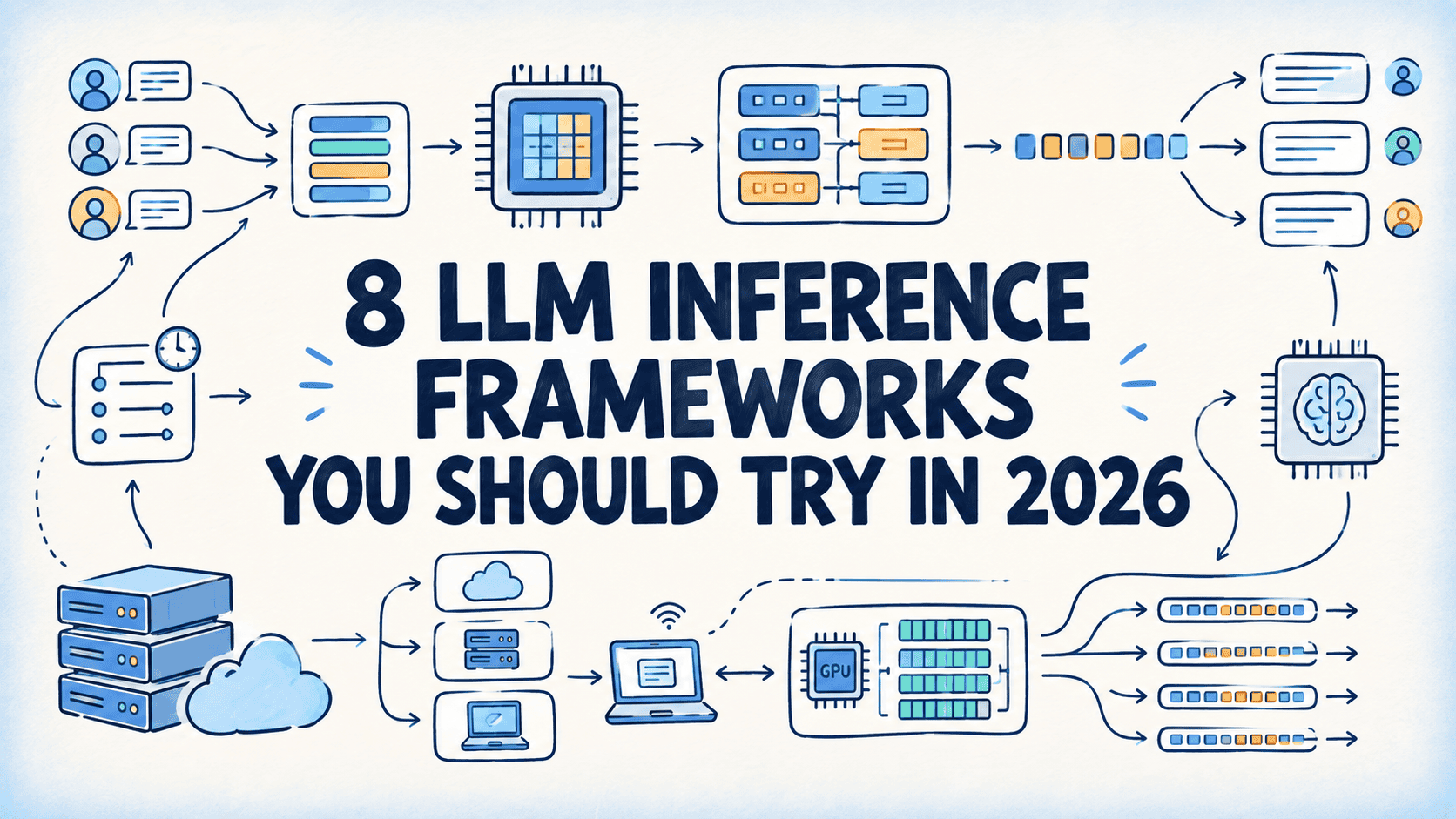
Compare LLM inference frameworks for production serving, request batching, KV cache management, and efficient deployment.
A model that runs in a notebook serves one request at a time. A production endpoint receives many requests at once, and each one needs GPU memory for its key-value (KV) cache, a slot in the batch, and a response stream. Plain PyTorch or Hugging Face Transformers can serve the model, but you have to build the request scheduling, cache management, and API layer around it yourself.
Inference frameworks supply those pieces. They sit between the model and your application and cover token generation, KV cache management, request batching, and the API surface, so you don't build that machinery for every model you ship. With a suitable framework, the same GPU can serve more concurrent requests at lower latency with no change to the model.
This article covers inference frameworks for high-throughput, data-center-scale serving, as well as tools designed for local, edge, and low-resource environments.
vLLM is one of the most widely adopted engines for serving large language models (LLMs) at scale, and developers moving off plain Transformers often start with it.
Here's why vLLM is great for many practical applications:
Start with the vLLM documentation, then look at its support for tensor parallelism if you're splitting a model across multiple GPUs.
SGLang pairs a fast backend runtime with a frontend language for describing model interactions, which suits workloads with complex prompting logic.
The SGLang GitHub repository is the best starting point, and its docs cover the frontend language in more depth.
MAX is Modular's serving framework, and it gives you control down to the kernel level.
The following are some useful features of MAX:
The MAX documentation shows how the serving flags map to your hardware.
TensorRT-LLM is NVIDIA's inference library for its own GPUs, and if your fleet is all NVIDIA, that focus tends to pay off in speed.
The following features make TensorRT-LLM worth the setup cost:
The NVIDIA TensorRT-LLM repository has the build instructions and model support matrix you'll need before committing to it.
LMDeploy is a toolkit for compressing, deploying, and serving LLMs, with a focus on decoding throughput and quantization.
Start with the LMDeploy quickstart guide. Its GitHub repository documents the supported model list and quantization options.
llama.cpp is a lightweight runtime written in plain C/C++ with no external dependencies. It supports many model families, including Llama, Qwen, DeepSeek, and Mistral.
The llama.cpp GitHub page is the fastest way to get a model running locally in minutes.
Ollama packages model download, versioning, and local serving behind a simple CLI and API, which makes it a common first inference tool for developers.
Why Ollama is super helpful for running and serving LLMs locally:
The Ollama documentation walks through installation, the model library, and concurrency settings.
MLC-LLM is a compiler-based engine built on Apache TVM, and it fits when your target hardware is unusual or your deployment spans multiple platforms.
The following features make MLC-LLM different from the rest of this list:
The MLC-LLM documentation covers weight conversion and model compilation, which web, iOS, and Android deployments need before the first run.
Here's a summary of what we've covered in this article:
Choose based on your traffic pattern, hardware, and deployment targets, and measure latency and cost on your own model.
Bala Priya is a developer, educator, and technical writer based in India. She writes about programming, data science, machine learning, and AI, with a focus on making complex technical ideas practical and approachable. She creates tutorials, how-to guides, and deep dives that help developers build, solve problems, and understand complex technical concepts. Her technical interests include LLM applications, agentic AI, graph algorithms, computer vision, explainable AI, and ML systems. When she’s not writing or coding, Bala is usually reading classic literature, epic fantasy, or speculative fiction... with a cup of coffee close by. She also enjoys talking about books, learning new things, and sharing what she learns with the developer community.
Get the FREE ebook 'KDnuggets Artificial Intelligence Pocket Dictionary' along with the leading newsletter on Data Science, Machine Learning, AI & Analytics straight to your inbox.
By subscribing you accept KDnuggets Privacy Policy