AI startup Vectorial lands $3M in funding to simulate human behavior for consumer research
Consumer research is a slow and cumbersome challenge that few companies do well, but if Vectorial AI Inc. is successful, they’ll never have to worry about doing it again. The startup today said it has raised $3 million in seed funding to propel the launch of its new artificial intelligence-driven p
SHARE UPDATED 08:00 EDT / OCTOBER 20 2026
Consumer research is a slow and cumbersome challenge that few companies do well, but if Vectorial AI Inc. is successful, they’ll never have to worry about doing it again.
The startup today said it has raised $3 million in seed funding to propel the launch of its new artificial intelligence-driven platform that simulates human behavior to generate valuable feedback for product development and marketing teams. Today’s round was jointly led by Smilegate and SenseAI Ventures, with additional funding coming from the ecosystem funds of the University of California at Berkeley and Stanford University. Angel investors from Meta Platforms Inc., Mastercard Inc. and Shopify Inc. also contributed to the round.
Vectorial believes it has identified a critical bottleneck in technology development. These days, virtually every company is using AI tools to generate massive amounts of code, accelerating the development of new software products and applications.
But consumer research is still stuck in the dark ages. Most firms still rely on outdated surveys of real audiences, which can take weeks to compile and complete, and are usually very limited in scale, with perhaps only 50 to 100 participants.
According to Vectorial co-founder and Chief Executive Taranveer Singh, many smaller startups simply avoid doing user research altogether, and just assume or hope they know what consumers actually want. But that’s hit-and-miss at best, and it leads to hours of wasted time and money spent on products no one needs.
“We believe AI is creating two distinct frontiers,” Singh told SiliconANGLE. “One focuses on reasoning and solving complex problems, while the other focuses on simulations and decoding human behavior.”
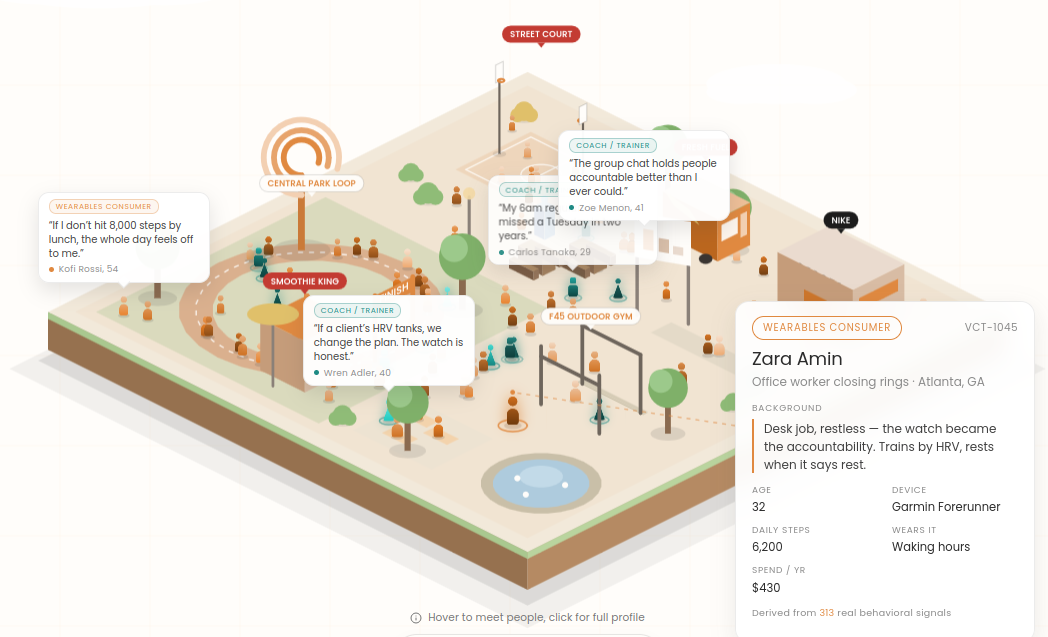
Rather than gather up real humans to test new products, Vectorial has built a platform that uses AI to simulate thousands of users within specified target demographics. It’s based on the concept of a “living model” of target customers that continuously updates itself to take into account emerging trends and behavioral shifts.
Singh says the feedback generated from these simulated audiences is extremely accurate, and he’s convinced that this method will become the standard for all new consumer products within the next four years or so. “Two pieces are missing,” he said. “The ability to simulate many scenarios, and the ability to bring your users into the same room as you build.”
Several other startups have tried to use AI to solve the consumer research conundrum before, but Singh believes that all of them have fallen short, because none of them actually models human behavior. One solution that’s been tried repeatedly is AI-moderated interviews, but these still take multiple days to organize because they’re still reliant on real humans, and they usually involve small sample sizes. Another popular approach is to use synthetic agents, but Singh says these lack grounding in real consumer behavior, which means their outputs can’t be trusted.
So how does Vectorial improve on these methods? Its solution is to embed its simulated audiences directly into companies’ development workflows, so developers receive a continuous flow of feedback that informs all of their decisions. Vectorial’s platform is powered by a behavior model called SAPIENS, which is continuously being trained on latent socio-demographic, psychographic and behavioral traits across a mammoth database of more than 2.5 million real consumers.
This makes SAPIENS 30% more accurate than general-purpose models when it comes to predicting consumer behavior, said Chief Product Officer Rahul Garg. It should get better too, for Vectorial will use the funds from today’s round to expand its behavioral dataset and build a more advanced model called SAPIENS 2.0.
“We continue to invest in our behavior model, but a model alone doesn’t solve the problem,” Garg said. “That’s why we put behavior models to work inside the product development loop. We believe this fundamentally changes how products are designed and built, because it puts users in the room where you build.”
The early results have been pretty good. Vectorial’s platform has already been put to use by e-commerce, gaming and healthcare firms such as GoodRx Inc., Boat, Everkind Inc. and Concrete Software Inc. Those customers run an average of 600 simulations per month, meaning they’re constantly getting feedback on every design change, feature implementation and so on. Vectorial has compared the findings of its simulated audiences with real user studies, and it typically achieves accuracy of around 86%.
This level of accuracy is one of the reasons why Rahul Agarwalla of SenseAI Ventures decided he had to back the startup. He said most companies struggle to understand their user’s needs, which means they’re hardly benefiting from the accelerated development times AI enables.
“Vectorial replaces the slow theater of surveys with millions of simulated humans using the product and providing insights,” he said. “This is a new class of AI designed to predict human behavior, and not just the next work like LLMs do.”
Support our mission to keep content open and free by engaging with theCUBE community. Join theCUBE’s Alumni Trust Network, where technology leaders connect, share intelligence and create opportunities.
Founded by tech visionaries John Furrier and Dave Vellante, SiliconANGLE Media has built a dynamic ecosystem of industry-leading digital media brands that reach 15+ million elite tech professionals. Our new proprietary theCUBE AI Video Cloud is breaking ground in audience interaction, leveraging theCUBEai.com neural network to help technology companies make data-driven decisions and stay at the forefront of industry conversations.
IBM-backed llm-d framework adds controls for running AI models in-house
Exclusive: Kantata's Expertise Insights answers services firms' business questions in plain English
Dream Labs raises $90M to help build more intelligent robots with simple video feeds
Trump administration orders ban on DeepSeek in federal agencies
AI work assistant startup Town secures unicorn status after raising $108M just weeks after launching
Amazon introduces toolkit for running PyTorch workloads on AWS Trainium chips
EMERGING TECH - BY MIKE WHEATLEY. 10 HOURS AGO
CLOUD - BY MARIA DEUTSCHER. 12 HOURS AGO
© 2026 SiliconANGLE Media Inc. All rights reserved.