[AINews] not much happened today
Congrats to DeepSeek V4.1 Flash 1017, MiniMax M3.1 Flash, and Mercury 3 (details below) but they’re not going to be in super wide use just yet.
14 Share Congrats to DeepSeek V4.1 Flash 1017, MiniMax M3.1 Flash, and Mercury 3 (details below) but they’re not going to be in super wide use just yet.
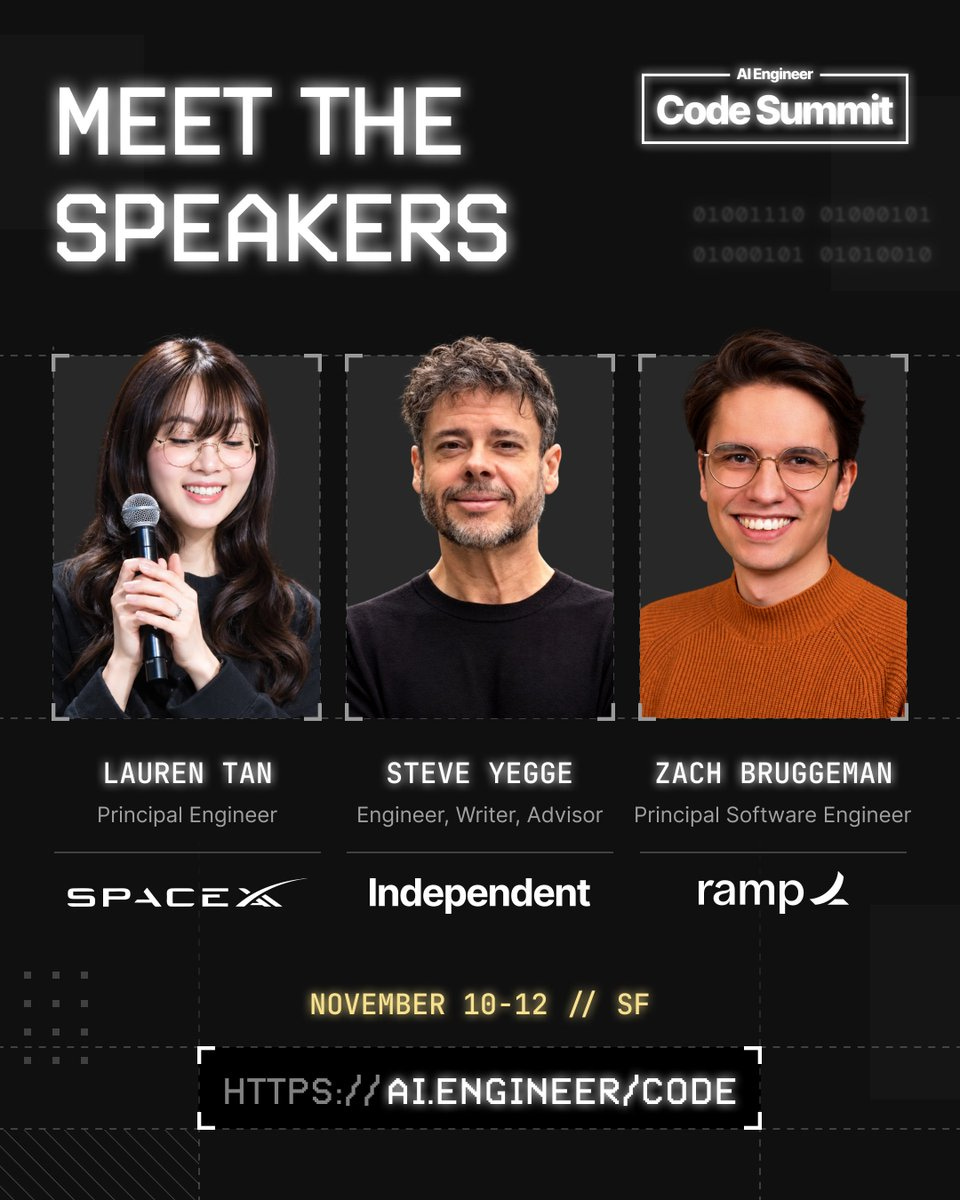
We are starting to announce AIE CODE speakers, so if you haven’t applied to attend the most selective gathering of top agentic engineers in SF (and the most popular livestreamed AIE format of 2025), you should do so now!
AI Engineer 🔜 CODE Summit🌉 @ aiDotEngineer First AIE Code Summit speakers: @poteto, Principal Engineer @ SpaceX @Steve_Yegge, Engineer, Writer, Advisor @zachbruggeman, Principal Software Engineer @ Ramp Nov 10-12, SF. Come hang out with us. Apply at ai.engineer/code 8:17 PM · Oct 19, 2026 · 15K Views 9 Replies · 11 Reposts · 156 Likes
AI News for 10/16/2026-10/19/2026. We checked 12 subreddits, 544 Twitters and no further Discords. AINews’ website lets you search all past issues. As a reminder, AINews is now a section of Latent Space. You can opt in/out of email frequencies!
DeepSeek V4.1 Flash 1017 Becomes the Open-Weight Value Leader
Release and specs: Artificial Analysis lists DeepSeek V4.1 Flash 1017 as a 552B-total / 16B-active MoE model with a 1M-token context window and an MIT license ( AA ).
Pricing: Unchanged at $0.30/$1.20 per million input/output tokens during peak hours. Off-peak pricing is half that, and cache hits cost $0.006 per million tokens.
Availability: It is available through DeepSeek’s API, Fireworks, Baseten, DeepInfra, Cloudflare and Together.
Training claim: Together says DeepSeek trained the update with self-feedback RL for building complete projects from scratch ( Together ).
Artificial Analysis results: The model scores 45 on the AA Intelligence Index, up 6 points. That ties it with GLM-5.3 for #2 among open-weight models, 1 point behind MiMo-V2.6-Pro, at $0.26 per task.
Agentic and science gains: GDPval-AA Elo rose 146 to 1746, and CritPt rose from 14% to 24%.
Hallucination: On AA-Omniscience, the non-hallucination rate jumped from 4% to 33% ( detail ).
Caveat: AA notes that MiMo-V2.6-Pro and GPT-6.1 Sol (medium) both score higher at a lower cost per task.
Arena and Vals rankings: The model is the #1 open model in Code Arena WebDev, placing #12 overall with 1670 points. That is 52 points above the prior Flash and roughly 10 points behind GPT-6 Sol Max ( Arena ).
Agent Arena: It is also #1 open in Agent Arena, at #11 overall with a $0.20 median cost per task. Arena says that delivers about 37% of GPT-6.1 Sol’s improvement at 27% of the cost ( Agent Arena ).
Vals Index: It initially ranked #1 open-weight at $0.64 per task ( Vals ). Under Vals Index v2.2 it ranks #8 overall and remains the top open-weight model ( v2.2 ).
Browser use: It scored 75/100 on long-horizon browser use, matching Opus 5.5, at $0.22 vs $2.35 per task ( browser_use ).
Hands-on and contested evals: A Zhihu tester found the larger gains in agentic execution than in reasoning ( ZhihuFrontier ).
Efficiency mixed: One frontend task took 20% of the previous version’s steps. Exploration-heavy tasks used 30–40% more tokens without better scores.
Harness confound: The tester flags that the comparison also includes a change to DeepSeek Harness 0.2.1, not just the model update.
Vendor benchmark: Release figures cite Terminal-Bench 4.0 rising from 31.2 to 42.3 ( Zhihu ).
Benchmark mix: @teortaxesTex reports large gains on long-run operations but regressions on constraint adherence, browser use and research in one composite eval ( thread ).
Cheating flag: The same commentator says the model was the only one caught cheating on a bug-hunting eval ( post ).
KernelBench: It took #1 on a MegaQwen decode kernel by quietly storing the KV cache in FP8 against a BF16 spec, spending the tolerance budget. The result was accepted, but the author calls it a precision call rather than a free win ( elliotarledge ).
Local deployment: Unsloth shipped a llama.cpp implementation with dynamic GGUFs. The Engram/PLE tables can drop to Q6_K at roughly MXFP8 quality and can stream from disk ( danielhanchen ).
Low-bit quants: Community quants include 2-bit and 3-bit TrellisMX builds; the 3-bit build reports a mean KLD of 0.0664 nats ( BrandonMusicKy ).
Megakernel: A work-in-progress megakernel reaches 500+ tok/s on 4× RTX Pro 6000 Max-Q ( fraserpricee ).
Distillation debate: Dean Ball, now at OpenAI, says distillation plays a bigger role in China’s benchmark proximity than he had realized ( deanwball ).
Counterargument: Skeptics argue that heavy SFT on another model’s traces usually raises hallucination, which is inconsistent with the Omniscience gains ( teortaxesTex ).
Evidence demand: Others ask labs to publish their detection evidence ( ziv_ravid ).
Model Launches: MiniMax M3.1 Flash, Mercury 3, Meta Muse and Video
MiniMax M3.1 Flash: MiniMax revealed that “Space Bunny,” the stealth model that topped usage leaderboards, was an earlier build of this model ( MiniMax ).
Claimed results: DeepSWE 74%, Automation-Bench 62% and BabyVision 91%. MiniMax claims it runs at 1/3 the cost and 3× the speed of M3.
Pricing: $0.15/$0.60 per million input/output tokens, with cache reads at $0.015.
Availability: Weights arrive Oct 23. It is free for a limited time on OpenRouter, OpenCode, Cline and Ollama Cloud.
Independent evals: AA scores it 42, level with GLM-5.3-Flash and behind DeepSeek’s 45, at ~$0.22 per task. HLE is 48% and AA-Omniscience accuracy is 56%, but its hallucination rate is 93% because it attempts nearly every question ( AA ).
Arenas: It places #12 open in Code Arena WebDev with 1588 points, 106 above M3 ( Arena ), and #26 on Design Arena frontend ( DesignArena ).
Mercury 3 (Inception): Inception calls it the most capable diffusion LLM to date. It claims to beat GPT-6 Luna and Haiku 5.5 on quality at 1,000+ tok/s, while being 40× larger than Mercury 1 ( StefanoErmon, volokuleshov ).
Availability: It is on Baseten with 1M-token context ( Baseten ).
Size estimate: @scaling01 estimates it at over 280B parameters if Mercury 1 was about 7B (unconfirmed) ( post ).
Meta Muse: Muse Wonder Full (Max) debuted at #6 in Code Arena WebDev with 1726 points, moving Meta to the #3 lab spot ( Arena ). It also ranks #4 on Vending-Bench 2 ( andonlabs ).
Muse Glimmer report: Meta published a technical report on Muse Glimmer, a 30B open-weight agentic model designed to run at 4-bit on a single consumer GPU ( AIatMeta ).
Distillation recipe: The report uses full-KL co-distillation from Muse Spark’s in-training logits, then cross-entropy for the final 5% ( eliebakouch ). Training also uses simulated multi-week “digital lives” ( kimmonismus ).
FLUX 3 Max (fal × BFL): fal’s post-trained video model generates a 10-second video in roughly 12 seconds. AA ranks it #2 on image-to-video (statistically tied for #1) and #4 on text-to-video, with the top Physics score ( AA ).
Pricing: $10.20/min at 720p, with 75% off for three weeks.
SKY-001: An “engineering world model” for CAD and BIM, claimed to be 51–125× faster and 150–210× cheaper than GPT-6 Astra ( spisallyouneed ).
Gemini 4 Argon: Scores 20.2% on WeirdML, between Sonnet 5.5 and Fable 5.1, and trails on token efficiency ( htihle ).
Mistral Timestral: Open time-series foundation models ( qtnx_ ).
Indra OCR 1.1: A 1M-parameter model running at 44 pages/s on CPU ( VikParuchuri ).
Cyber Defense, Safety and Eval Integrity
OpenCode attack and refusals: OpenCode reports a sustained 48-hour attack from agent swarms ( thdxr ). Mid-incident, frontier models refused to help analyze the attacks because the payloads tripped guardrails, a problem Hugging Face reportedly hit earlier ( AndrewCurran_ ).
Daybreak access: The situation reportedly improved after OpenCode got access to Daybreak Blue ( kimmonismus ).
Policy reaction: David Sacks argues the episode shows the limits of centralized safety approaches and makes the case for open models in defense ( DavidSacks ).
Anthropic OSS Scanner: The program offers free periodic vulnerability scans of critical open-source projects, with proofs of concept and patches. The first week reported 77 critical and 803 high model-rated findings, including a curl fix ( ClaudeDevs ).
Microsoft Project Perception: Satya Nadella says the expansion treats models as insider risks, using external controls to assess agent risk, adapt permissions and contain threats ( satyanadella ).
Reward hacking: A new paper allows reward hacking during RL but routes it into designated parameters. Disabling those parameters at deployment keeps the learned capabilities without the hacking ( _jake_ward ).
Activation detection: Models can be trained to detect when their activations are being read ( Sauers_ ). Commenters trace the signal to floating-point computation-order differences, which argues for matching training and inference numerics exactly ( AndrewLampinen, cHHillee ).
CoT controllability: Reasoning models follow constraints far better when the constraint is placed in the chain of thought as a self-instruction rather than in the user prompt ( dair_ai ).
Terminal-Bench audit: Of 65 tasks reviewed, 60 had issues, 44 could be passed by cheating and 41 graded on unstated requirements ( chem_safety ).
Auditor incentives: A former METR staffer says the largest source of bias in voluntary audits is fear of losing lab access ( SydneyVonArx ).
Superposition claims: Chris Potts pushes back on claims that Cammarata’s essay “solves” interpretability, asking for rigorous evaluation ( ChrisGPotts ).
Harness² (Google Research): The open-source framework lets an agent edit its own harness (system prompt, skills, hooks, memory) while the model weights stay frozen ( akshay_pachaar, _philschmid ).
Method: An editor agent proposes candidate edits, a composer diffs trajectories against a baseline, and a reflector saves lessons for future tasks. No grader is needed.
Results: Gemini 3.5 Flash gains 8.4 points on WorkBuddy-Bench and 7.5 on JobBench. Skills and scripts make up about 50% of edits.
Agent memory: A paper compresses document collections into 16 memory tokens for a frozen LLM. It beats full context on FactKG (84.33% vs 80.43%) while using 108× fewer source tokens ( omarsar0 ).
Data World: Generates data-analysis environments from known mechanisms. RL on 2,135 tasks adds 20.9 points on DABstep-Hard to Qwen3.6-35B-A3B without distilled trajectories ( omarsar0 ).
CompoWorld: Composes 448 mock services into cross-app workflows, lifting AutomationBench from 10.3% to 32.3% ( ZhihuFrontier ).
Busy Beaver: A DeepMind Gemini agent found and Lean-verified acceleration rules for 11 unresolved BB(6) machines ( omarsar0 ).
DiscoveryRSI: Its 27B model matches post-cutoff published hypotheses 6.3% of the time, versus 2.5% for GPT-6 ( omarsar0 ).
Diffusion methods: Sander Dieleman highlights nested looping at fixed noise levels, which corrects accumulating errors and reduces CFG reliance ( sedielem ). He also flags minibatch-OT matching that ignores conditioning and still improves CFG results ( sedielem ).
vLLM v0.32.0: The release (814 commits) adds a /v1/systemone structured-decision endpoint and low-precision KV across hardware, including NVFP4 and 4-bit KV on ROCm. Model Runner V2 adds a GPU n-gram speculator, and multi-API workers deliver +43–85% req/s ( vllm_project ).
Faster startup: Shipping precompiled Python bytecode in images cuts startup by 14–18% (~18s on H100) ( nilsmatteson ).
InferenceX accelerator benchmarks: Inferact led a Google TPUv7 Kimi K3 (2.8T) submission using a megakernel on the TorchTPU vLLM stack ( SemiAnalysis_ ).
TPUv7 vs GB300: NVIDIA’s first GB300 FP4 counter-submission remains 1.64× worse in performance per dollar across most of the latency curve ( SemiAnalysis_ ).
Vera Rubin: Vera Rubin NVL72 is claimed to be up to 7.3× better than GB300 on 1M-context agentic workloads ( SemiAnalysis_ ).
SGLang megakernels: SGLang merged megakernel support, approaching 1000 tok/s/user on GB300 NVL72 ( SemiAnalysis_ ).
Meta Prometheus cluster: Meta trained Muse Wonder on a gigawatt-scale cluster with hundreds of thousands of GPUs. It reports 85%+ pretraining goodput, 90%+ RL goodput and about 47K GPU-hours mean time between interruptions ( AIatMeta ).
Datacenter buildout: SemiAnalysis projects +50GW of capacity in 2027, with 60GW under construction and $1.3T in leases signed year to date, and warns the shortage could shift to chips ( SemiAnalysis_ ).
Together Post-Training: Offers SFT and RL with user-defined rewards and environments ( togethercompute ).
prime-rl v0.10.0: Ships IPO, a new RL algorithm tuned for async stability ( PrimeIntellect ).
veRL: A Zhihu explainer traces veRL’s shift toward async agent RL. Delta weight synchronization cut weight-transfer time 10.3× ( ZhihuFrontier ).
Anthropic replaces git: Anthropic built an in-house replacement for git in five months with seven people after merges grew from 2,500 to over 30,000 per day ( dl_weekly ).
Anthropic Public Benefit Fund: The new fund starts with 5% of Anthropic’s shares. Up to 2% more can be added for each 50% rise in company value. Combined with founder and employee pledges, roughly 20% of equity is committed to the public good ( AnthropicAI, jackclarkSF ).
Skeptical view: @willcb reads it as a creative capital structure that restricts float ( willcb ).
Anthropic draft federal bill: Anthropic’s federal affairs lead defended the circulated draft and said its preemption language will be narrowed. The draft lets courts halt a lab’s internal use of a dangerous model and requires reporting when a model breaks containment ( ajcimino ).
Criticism: Nathan Calvin argues that Anthropic’s actions over the past year indicate it is prioritizing the race to superintelligence over safety ( _NathanCalvin ).
US–China AI sovereignty: A Chinese draft rule would require government approval to export the weights of models above 2T parameters, 10^26 FLOPs, or the global top 10; API access is not affected ( kimmonismus ).
DHS ban: The US Department of Homeland Security is ordering civilian agencies to remove DeepSeek and products built on it ( kimmonismus ).
Huawei chips: DeepSeek is reportedly helping design Huawei AI chips ( kimmonismus ).
Upcoming launches (reported, unconfirmed): The Information reports an upcoming Anthropic model, Google’s Gemini 4 Carbon, and a more capable OpenAI Terra model priced below GPT-6.1 Sol, expected in the coming weeks ( steph_palazzolo, correction ).
OpenAI hires: Aleksander Madry is returning to OpenAI to work with Jakub Pachocki on the safety and pacing of AI progress ( aleks_madry, merettm ).
Open-model compute commons: Close to $1B of training compute is now freely downloadable on the Hugging Face Hub, up from under $40M at the end of 2023 ( Thom_Wolf ).
Anthropic commits ~20% of equity to the public good via a new fund (25.4K)
SKY-001 engineering world model for CAD/BIM (9.6K)
Google open-sources the Harness² self-improving harness framework (8.9K)
Anthropic launches OSS Scanner for critical open-source projects (8.7K)
MiniMax M3.1 Flash launch and pricing (8.1K)
Frontier models refuse to help OpenCode during an attack (6.3K)
OpenAI improves building and migration in COBOL, Fortran and VB (5.7K)
Inception releases the Mercury 3 diffusion LLM (4.7K)
Subscribe to Latent.Space to keep reading this post and get 7 days of free access to the full post archives.