Choosing a Chunking Strategy for Your LLM Apps: A Decision-Tree Approach
In this article, you will learn how to choose the right chunking strategy for a retrieval-augmented generation system by working through a structured decision tree...
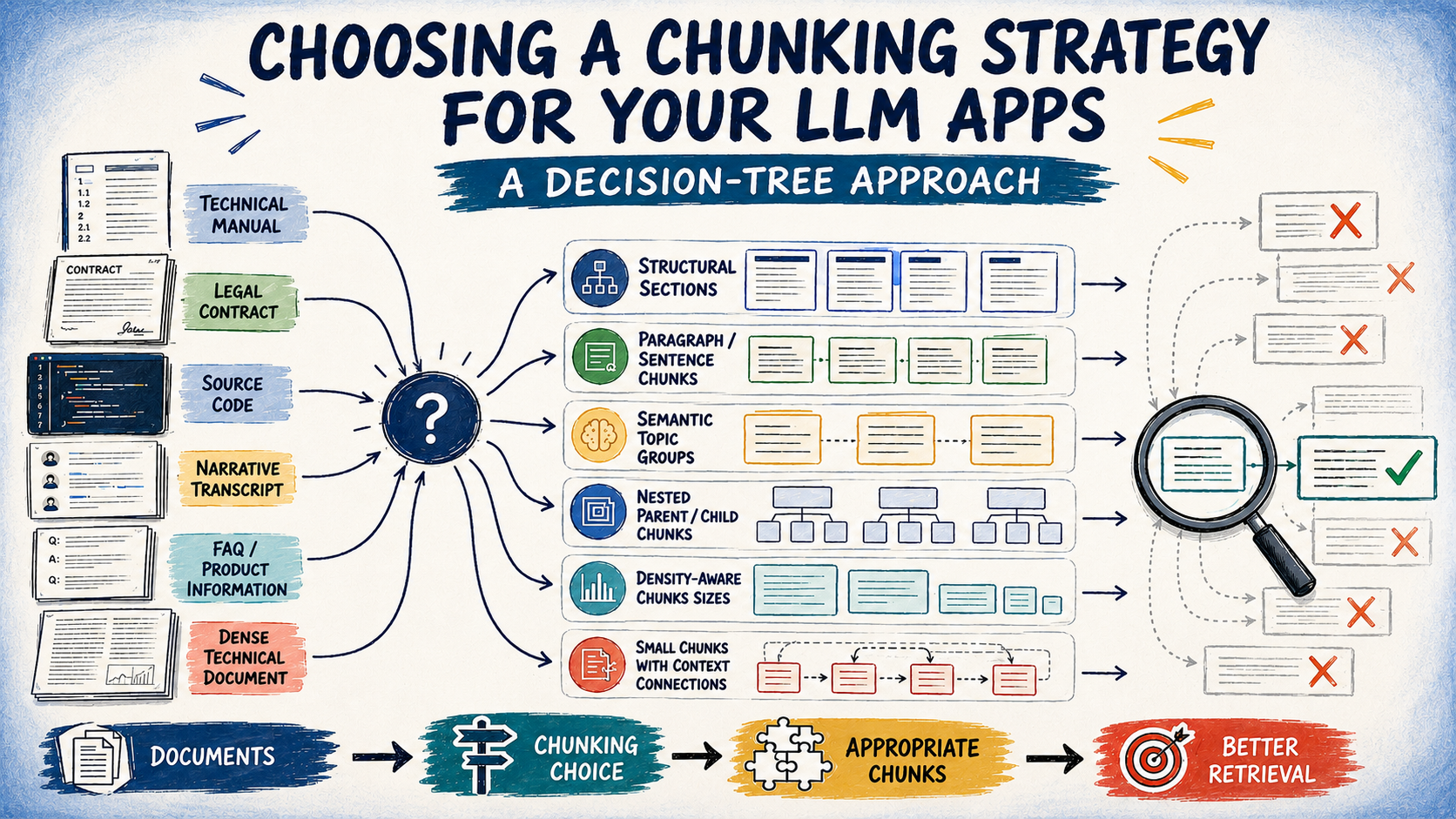
Share Post Share In this article, you will learn how to choose the right chunking strategy for a retrieval-augmented generation system by working through a structured decision tree tied to the properties of your documents and retrieval task.
When you are building a retrieval-augmented generation system, you often work with documents that are larger than what an embedding model or LLM context window can accommodate, so you need to split them into smaller chunks. Chunk size and overlap may seem like straightforward configuration choices, but the way you set those boundaries directly affects retrieval. Poor boundaries can cause retrieval to miss the passage that answers a query, or return a chunk that is technically relevant but lacks the surrounding context needed to make it useful.
A chunking strategy defines how you decide where to split a document, and that choice can have a major effect on retrieval quality. When the boundaries preserve the right context, embeddings, vector search, and generation have a stronger basis to work with. When the boundaries break important context, reranking and prompt tuning cannot fully recover what was lost during splitting. No single chunking method works well for every document. The right choice, therefore, depends on the structure of the document and the retrieval task.
We start with why this choice is important.
Each chunking strategy is based on a specific assumption about the document. Choosing a strategy that matches the document’s structure and needs helps improve retrieval quality while avoiding unnecessary complexity:
When the strategy fits the document, its added complexity can be worthwhile. When it does not, it adds overhead without improving retrieval. For example, semantic chunking is unnecessary for a short FAQ entry, while fixed-size chunking can split related clauses in a contract. These mismatches can lead to retrieval problems that originate in preprocessing rather than generation.
The tree has six branching questions, each narrowing the strategy space based on a concrete property of the document or the retrieval task. Every question below ends with a direct answer: which strategy to use if the condition holds, and where to go next if it doesn’t. Following them in order helps you choose a strategy based on the document and retrieval task rather than defaulting to a familiar option.
Short, self-contained content — such as FAQ entries, product descriptions, or single config snippets — often fits comfortably inside one embedding call and covers exactly one topic.
If the document sits well within the model’s context window and doesn’t mix subjects, embed it whole and skip chunking. Splitting content that is already coherent only adds retrieval overhead. If the document is too long, or covers more than one topic, move to Question 2.
Some documents already contain natural boundaries that reflect how their content is organized. Markdown headings, HTML elements, PDF sections and tables, and code functions or classes can all provide meaningful chunk boundaries.
If the document has a reliable structure that maps to logical content units, use document-based chunking. The document is parsed according to its format, keeping sections, paragraphs, tables, functions, or other structural elements together. If the structure is inconsistent, incomplete, or doesn’t provide useful boundaries, move to Question 3.
Some documents carry dependencies that span the whole text. Take, as an example, a legal contract that defines a term in section one and uses it in section eight, or a technical spec whose terminology only makes sense next to an earlier paragraph.
If retrieval needs to preserve that document-wide relationship, use late chunking. Embed the full document with a long-context model first, then derive chunk-level embeddings from that result, so each chunk still carries a trace of the whole document. If chunks can stand on their own without losing meaning, move to Question 4.
This question covers two different conditions, each pointing to a different strategy:
If neither condition applies, move to Question 5.
This is the cost and quality tradeoff. If retrieval quality is the priority and the budget supports a model call per document, use LLM-based chunking to identify logical breakpoints or atomic propositions. If quality still matters but per-document model calls are too costly, and topic shifts are unpredictable, use semantic chunking based on sentence-embedding distance. It is less costly than an LLM pass while still accounting for meaning. If speed and cost are the priority, move to Question 6.
If the corpus mixes document types where the right strategy differs from one document to the next, use agentic chunking. For example, a collection might contain structured reports, narrative transcripts, and code. An agent can inspect each document and select the appropriate approach.
If the collection is reasonably uniform, recursive chunking is a practical default. It splits content at paragraph, sentence, and then word boundaries until the chunks fit the target size, while preserving natural structure without requiring per-document analysis.
If speed matters more than chunk quality, fixed-size chunking is a reasonable fallback for quick prototypes. After working through these questions, the decision tree should look like so:
Working through the tree lands you on one of the strategies below. Systems often blend more than one, but the table maps each strategy to the situation it fits best and the cost that comes with it:
The right chunking strategy depends on the structure, complexity, and retrieval needs of your data, with the goal of balancing retrieval quality, computational cost, and implementation complexity.
A strategy that looked right on paper can still misbehave once it meets actual documents. The table below lists the signals worth watching for, what they usually mean, and the fix that tends to work:
These pitfalls can help you identify when a chunking strategy needs to be adjusted for better retrieval and efficiency.
Choosing a chunking strategy starts with understanding the structure of your documents and the retrieval task they need to support. Factors such as document structure, context dependencies, information density, retrieval requirements, and cost all shape that choice.
Use the decision tree to identify a suitable starting point, then validate it with your own queries and retrieval results. Start with the simplest strategy that fits your needs, and introduce more advanced approaches only when they address a specific retrieval challenge.
The best results come from matching chunk boundaries to the information you need to retrieve, while keeping the added complexity proportional to the value it provides.