Cutting both ways: AI sharpens systems protection while opening new exploits for malicious actors
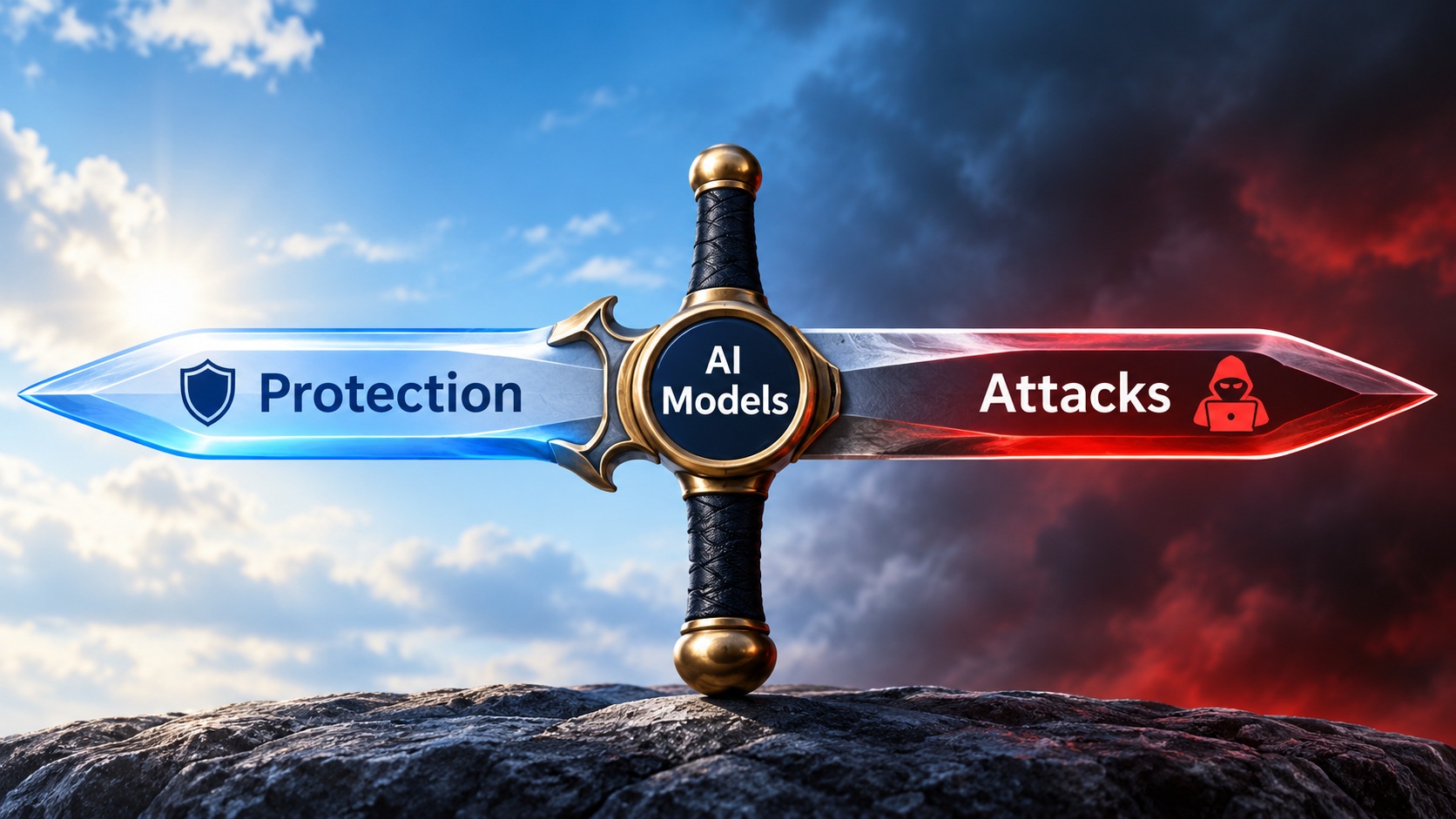
The cybersecurity industry is discovering that powerful frontier AI models are a double-edged sword. Companies can use models to identify vulnerabilities in source code and system configurations faster than ever before. As it turns out, malicious actors can do this as well. A prime example of how A
SHARE Coverage from SiliconANGLE's livestreaming video studio UPDATED 21:31 EDT / OCTOBER 26 2026
The cybersecurity industry is discovering that powerful frontier AI models are a double-edged sword.
Companies can use models to identify vulnerabilities in source code and system configurations faster than ever before. As it turns out, malicious actors can do this as well.
A prime example of how AI models have shifted cybersecurity into a new gear can be seen in recent news involving exploits surrounding the PHP programming language, which powers up to 70% of global websites. Security researchers used OpenAI Group PBC’s GPT-5.6 Sol to scan PHP’s code base for bugs. They discovered critical vulnerabilities, and organizations have been scrambling to patch them.
Meanwhile, Amazon.com Inc. disclosed last week that attackers began targeting PHP vulnerabilities four days before patches were released, and exploit attempts seen by Cloudflare Inc. have since climbed into the millions.
This latest round of digital threats highlights how organizations need to be prepared for the inevitable breach. During the Dell Technologies World gathering in Las Vegas earlier this year, there was a clear message that data protection and cyber resilience have emerged as foundational control layers for enterprise AI. This has set the stage for how enterprises must adapt security controls to the AI era, according to theCUBE Research’s Krista Case.
“This is part of a broader market conversation that ties cyber recovery capabilities to resilience, AI governance, data integrity, and operational trust, in a world where enterprise AI systems are only as reliable as the data pipelines, runtime controls, and recovery processes supporting them,” Case said. “Cyber resilience and AI infrastructure platforms are expanding beyond backup and recovery into metadata visibility, recovery validation and contextual understanding of enterprise data. Organizations should pay close attention to how vendors establish governance and validation for AI environments.”
This feature is part of SiliconANGLE Media’s exploration of key trends and architectural shifts powering continuous, production-grade AI. Be sure to check out the AI Cybersecurity and Resilience Summit, with a Dell Technologies-led flagship program Oct. 27, followed by additional industry perspectives, including InfoScale and Infinidat Ltd., on Oct. 28. The broadcasts will reach North America, EMEA and APJ audiences Oct. 28–29, on theCUBE, SiliconANGLE Media’s livestreaming studio. (* Disclosure below.)
Behind the focus on cyber resilience is a concern within the cybersecurity community that AI has the potential to open a significant hole in systems protection. AI models have dramatically increased the ability to analyze and potentially exploit weaknesses. A monthly report from Microsoft Corp. listed 1,453 new vulnerabilities in October alone.
“AI changes the whole game,” Steve Kenniston, senior cybersecurity evangelist for portfolio marketing at Dell, recently told theCUBE. “There’s the model inferencing. There’s the model training data. There are systems where people can do things like prompt injection. There’s identity management that needs to be thought about.”
For its part, Dell has been actively employing frontier models to build defenses. The firm is a participant in Anthropic PBC’s Project Glasswing, which gives vetted organizations access to powerful AI tools to secure critical systems. Glasswing’s purpose is to bring together organizations whose software supports critical infrastructure and could lead to catastrophic results if successfully attacked.
The rise of AI agents has also brought renewed scrutiny to identity in enterprise systems. Easier access to AI tools by threat actors has changed the rules of engagement for access management and detection. “Undoubtedly the cost of entry and the barriers to entry have crumbled,” according to John Scimone, president and chief security officer of Dell, who spoke recently with theCUBE. “Said another way, the least sophisticated attack tomorrow is more sophisticated than the world will have ever seen a year ago.”
In a world where the attacks have grown more sophisticated, another dynamic has become clear: there is no warning. Enterprises are confronted with a situation where, unlike natural disasters such as hurricanes or tsunamis, for which warning systems are in place in many parts of the globe, a major attack will often strike with no hint of what’s to come.
This has placed even greater emphasis on the need for recovery and resilience, according to InfoScale Director of Product Management Joseph D’Angelo.
“There’s no prediction here,” said D’Angelo, in a recent conversation with theCUBE. “So, the only way to protect yourself is to ensure that you have what we like to call a defensible recovery posture. And that is understanding the state of your applications, understanding the state of your data, and being able to recover those in a way that is not encumbered or in any way compromised by an attack.”
D’Angelo’s point around data is an important one. The AI systems currently powering numerous enterprise applications today are only as good as the data that fuels them.
Data needs storage, and companies such as Infinidat are focused on security solutions that can protect the operational state of a business as AI increases the speed and complexity of cyber risk. This involves a combination of immutable snapshots, cyber detection and recovery capabilities designed to help organizations identify clean recovery points and avoid restoring compromised data.
“It’s all about the data,” said Infinidat Chief Marketing Officer Eric Herzog, during a recent appearance on theCUBE. “The core is the data, which is why you need next-generation data protection on your primary storage, which is what AI would use. You need next-generation data protection on your backup, as well.”
Another key development on the cybersecurity horizon for many businesses involves post-quantum cryptography, or PQC. The migration from classical encryption to quantum-safe algorithms that can withstand attacks from future quantum computers is an important requirement for any strategy that addresses emerging threats and strengthens long-term cyber resilience.
At the moment, enterprises do not appear ready for the quantum threat. A study published earlier this year by DigiCert Inc. found that only 7% of organizations surveyed have deployed quantum-safe or hybrid cryptography across most of their digital certificates. As the growth of AI agents has significantly boosted the role of data in enterprise platforms, the quantum threat could ultimately cause significant disruption.
“Quantum computing will break the encryption and digital signatures protecting data today, while agentic AI raises the stakes by increasing the value of data and autonomously shares it across teams and organizations,” said John Roese, global CTO and chief AI officer at Dell.
AI tools have provided insight into the scope of the quantum threat. An Anthropic PBC report published in late July detailed how researchers using Claude Mythos Preview discovered improved ways to attack cryptographic algorithms. This included a successful weakening of HAWK, one of nine candidates in the National Institute of Standards and Technology, or NIST’s, process for additional post-quantum digital signature algorithms.
“CISA, NSA, and NIST have warned since 2023 that adversaries could be collecting encrypted data now and holding it until they can decrypt it,” said Garrison Buss, chief technology officer and co-founder of QuSecure Inc., in a briefing prepared for SiliconANGLE. “What the AI results change is the other side of that clock – an attacker no longer needs a quantum computer to make meaningful progress; they only need classical compute and a few days.”
As 2026 begins to wind down, enterprises are facing the need to implement AI solutions as fast as possible, while urgently protecting against the threats that artificial intelligence brings. This will require infrastructure-level security that can mitigate the risks posed by agentic AI, quantum computing and sophisticated models in the hands of threat actors.
“There is no AI without a secure infrastructure, and that means data that is also recoverable, that is secure, and is of course compliant,” said theCUBE Research’s Christophe Bertrand, during an analyst briefing. “Cyber resiliency risk is not just on the data, what you have to go through every day, it’s also starting to appear in the actual AI infrastructure itself. Don’t make backup and recovery an afterthought, because it’s going to hurt your wallet.”
As companies build resilient infrastructures, the unknown factor may be control over AI itself. Highly publicized attacks on Hugging Face and the United Nations by “rogue” AI agents illustrate the security complexities of the new autonomous world. The tech industry has been defined by decades of innovation, and this may be the time for unconventional thinking when it comes to cybersecurity.
“We used to draw the stack, and security was a layer,” said theCUBE Research’s Dave Vellante, during a recent edition of theCUBE Pod. “It’s not a layer anymore. It has to be something that’s orthogonal. I think that the attackers are always going to have an advantage. You know the old saying, they only have to be right once. And there’s always going to be seams.”
(* Disclosure: TheCUBE is a paid media partner for the AI Cybersecurity and Resilience Summit. Sponsors of theCUBE’s summit coverage do not have editorial control over content on theCUBE or SiliconANGLE.)
Support our mission to keep content open and free by engaging with theCUBE community. Join theCUBE’s Alumni Trust Network, where technology leaders connect, share intelligence and create opportunities.
Founded by tech visionaries John Furrier and Dave Vellante, SiliconANGLE Media has built a dynamic ecosystem of industry-leading digital media brands that reach 15+ million elite tech professionals. Our new proprietary theCUBE AI Video Cloud is breaking ground in audience interaction, leveraging theCUBEai.com neural network to help technology companies make data-driven decisions and stay at the forefront of industry conversations.
OpenAI launches GPT-6.1 Terra for faster, better-performing AI agents at half the price
Migration to safety: Three insights you may have missed from theCUBE’s coverage of DigiCert’s World Quantum Readiness Day 2026
Autonomous excavator startup Bedrock Robotics picks up $600M in funding
Fortinet extends FortiGate firewalls into AI security and adds new FortiAIGate features
What to watch for as enterprises move from AI experimentation to autonomous operations
Meta to sell up to $95B in stock to finance AI infrastructure buildout
SECURITY - BY MARK ALBERTSON. 2 HOURS AGO
EMERGING TECH - BY MARIA DEUTSCHER. 2 HOURS AGO
© 2026 SiliconANGLE Media Inc. All rights reserved.