Emil Michael tells The Information export controls can rein in AI labs
Emil Michael says the US government can use export controls on AI companies that do not cooperate with it. The under secretary of war is the Pentagon’s chief technology officer. He made the case in a video interview with Amir Efrati and Leo Schwartz of The Information, which reported it on Monday.
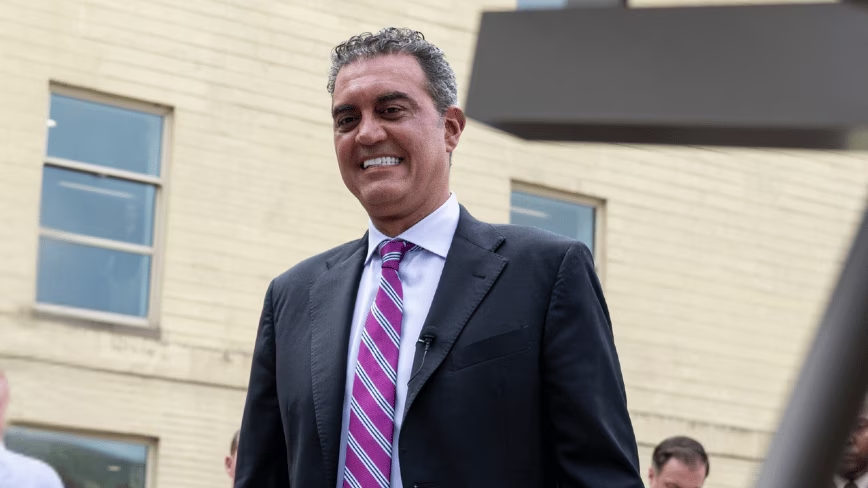
Emil Michael at a display of autonomous systems at the Pentagon, July 2025.
Emil Michael says the US government can use export controls on AI companies that do not cooperate with it. The under secretary of war is the Pentagon’s chief technology officer. He made the case in a video interview with Amir Efrati and Leo Schwartz of The Information, which reported it on Monday.
Michael spoke the day after the first full meeting of the White House’s new AI task force, the Super Intelligence Force. As a vice chair, he is responsible for the government’s relationship with the labs and for how they report incidents.
A White House official had named export controls as one possible stick. Asked whether they were an appropriate way to keep companies in line, Michael said they were. He pointed to past limits on exporting encryption and to limits on foreign nationals using a technology. The executive branch has many other tools, he said, including enforcement by the Justice Department.
He said the government had already shown it would act. According to Michael, Anthropic refused to pull back a model after the government found out it was jailbroken. Within two hours, he said, the company was under export controls.
“I think you can count on this administration, this president to act with urgency should there ever be a real issue.” Emil Michael, to The Information
Michael also questioned AI companies that call for regulation. He described companies that ask the government to stop them because they could do something dangerous, so that rivals do not get there first. He said that made little sense.
“I’m the drunk driver in the car. You’ve got to pull me over.” Emil Michael, describing that argument, to The Information
The laws that already exist are “more than sufficient”, he said. That is based on his own reading and on what FTC chair Andrew Ferguson has told him.
Anthropic is out of the Department of War, as the department said six months ago it would be, Michael said. The Pentagon has labelled the company a supply chain risk. Anthropic has asked the full appeals court to rehear its case. Michael said he expects the government to win.
He said he still talks to the company. He saw chief executive Dario Amodei at a White House event a few weeks ago. In the task force’s work, he expects to treat Anthropic in a fair, even-handed way, like the other labs.
Working with Anthropic at the department is another matter. Michael objected to the idea that a model has feelings and can overrule the founders of a company. He said Anthropic builds that principle into its software through the constitution it attaches to its models.
“If you don’t want humans to lose control, you can’t give models the control over humans.” Emil Michael, to The Information
In the military, a model cannot come between a commander and their superior, Michael said. Unless Anthropic changes that, there is no discussion, he added. Elon Musk and Google signed the same terms of use, which cover all lawful uses, he said.
About 1.7 million of the department’s 3.5 million employees now use AI, up from 80,000 a year ago, Michael said. In June, the Pentagon’s AI platform had 1.5 million users.
Michael said he favours American open-source models, naming Nvidia’s Nemotron, Reflection AI and Thinking Machines, though none of them is yet at the frontier. He worries a little about Chinese open-source models becoming dominant in the US, he said, because their makers are subject to the rule of the Chinese government.
The task force’s work will produce an incident response framework, plans to harden critical infrastructure and a review of the laws that already apply to AI companies, he said. Separately, the President’s science advisers will study whether the US needs new laws.
Alina Maria Stan builds connections that people actually feel. As co-founder and COO of Tekpon, she turns product intuition into real moment (show all) Alina Maria Stan builds connections that people actually feel. As co-founder and COO of Tekpon, she turns product intuition into real moments of discovery, shaping how teams find and adopt SaaS every day.
Since 2020, she has led Tekpon’s brand voice, media strategy, and growth plays with a clear focus on human outcomes behind every metric. Before Tekpon, Alina followed curiosity across industries and countries. She was CEO of King Casino Bonus and led affiliate and brand strategy at Extremoo Media and Fable Media in Denmark, where she learned how to build partnerships that last.
Early on, she sharpened her CRM and pricing instincts at K.H. ApS, always asking why customers choose what they choose. Her approach is rooted in more than a decade of international experience and two master’s degrees, one in Sustainable Consumption from the Technical University of Munich and one in Consumer Affairs Management from Aarhus University.
Get the most important tech news in your inbox each week.
Thanks! Check your inbox to confirm your subscription.
By subscribing you agree to our Privacy Statement.