Google drückt kostenlose Gemini-Nutzer auf Flash-Lite und lanciert Nano Banana 2.1
Nutzer ohne bezahlten Google-AI-Tarif verlieren im Gemini-App zwei der drei bisher verfügbaren Modelle und landen bei Gemini Flash-Lite. Der Schritt kommt nur Tage nach dem Release von Nano Banana 2.1, einem neuen Bildmodell auf Basis von Gemini 3.
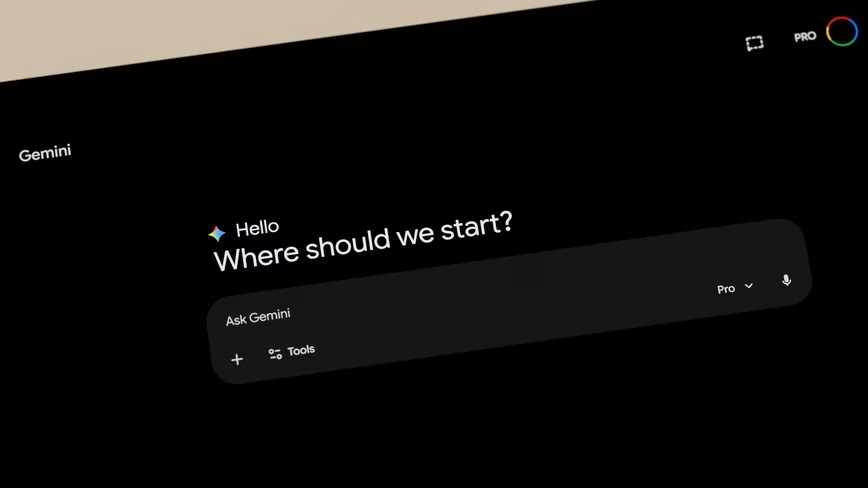
Ab heute verlieren Nutzer der Gemini-App ohne kostenpflichtigen Google-AI-Tarif zwei der drei verfügbaren Modelle. Kostenlose Privatkonten wechseln laut der Gemini-Apps-Hilfeseite von Google ausschließlich zu Gemini Flash-Lite. Die Änderung kommt nur drei Tage nachdem Google Nano Banana 2.1 veröffentlicht hat, ein neues Bildmodell auf Basis von Gemini 3.6 Flash.
Abonnenten von AI Plus, dem günstigsten Tarif von Google, behalten Flash-Lite und Flash, verlieren jedoch Pro. Google erklärt, diese Nutzer würden eine E-Mail erhalten, die ihnen mitteilt, wann die Änderung für sie gilt. AI-Pro- und AI-Ultra-Abonnenten behalten alle drei Modelle.
Google hatte Nano Banana 2, auch Gemini 3.1 Flash Image genannt, am 26. Februar als Vorschau veröffentlicht. Am 17. Mai stellte die公司将 Gemini-App-Nutzer über 18 auf nutzungsbasierte Limits um. Diese Limits erneuern sich alle fünf Stunden, bis der Nutzer ein wöchentliches Maximum erreicht. Die Komplexität der Prompts, die verwendeten Funktionen und die Länge eines Chats zählen dabei alle mit.
Mediengenerierung, Deep Research, das Pro-Modell, extended thinking und Deep Think verbrauchen das Limit schneller. AI-Plus-Abonnenten erhalten das Doppelte der Standardlimits, AI-Pro-Abonnenten das Vierfache. AI Ultra bietet das Fünf- oder Zwanzigfache des AI-Pro-Limits, je nach Tarif. Nutzer unter 18 wurden am 24. Juli auf die neuen Limits umgestellt.
Google aktualisierte die Hilfeseite in den ersten Tagen des Oktober, und 9to5Google berichtete am 3. Oktober über die Änderung. Abner Li nannte die Modelle Gemini 3.5 Flash-Lite, Gemini 3.6 Flash und Gemini 3.1 Pro.
In den USA kosten Googles AI-Tarife laut 9to5Google 4,99 Dollar monatlich für AI Plus und 19,99 Dollar für AI Pro. AI Ultra kostet 99,99 oder 199,99 Dollar. AI-Pro-Abonnenten erhalten zudem Deep Think, eine bisher den Ultra-Tarifen vorbehaltene Reasoning-Option, so die Website.
Google führt außerdem die Stufen low, medium und high für den Aufwand jedes Modells ein. Gemini bietet derzeit lediglich eine einzige Option namens extended thinking an, so 9to5Google. Auf Googles Hilfeseite heißt es, eine höhere Stufe habe ihren Preis:
„Dies erhöht die Fähigkeit des Modells, Aufgaben zu erledigen und ausführlichere Antworten auf Anfragen zu geben, verbraucht aber auch mehr Ihres Limits.“ Google, Gemini Apps Help
Am 6. Oktober veröffentlichte Google Nano Banana 2.1 für die Bildgenerierung und Bildbearbeitung. Seine Modellkarte nennt die Gemini-App, Google AI Studio, die Gemini API, AI Mode in der Suche, Google Ads, Flow und Stitch. Am selben Tag berichtete The Verge, dass kostenlose Gemini-Nutzer weiterhin zwischen Flash-Lite, Flash und Pro wählen könnten.
In Googles Tests mit menschlichen Präferenzen erreichte Nano Banana 2.1 mit thinking einen Wert von 1050 für die Gesamtpräferenz bei Text-zu-Bild. Nano Banana 2 erreichte 990 und Nano Banana Pro 935. Google listet bekannte Einschränkungen auf, darunter unscharfen kleinen Text bei 1K-Auflösung und gelegentliche Verwechslungen zwischen links und rechts.
Bei der Gemini API beziffert Googles Preisliste ein 1K-Bild auf 0,0336 Dollar, gegenüber 0,067 Dollar für Nano Banana 2. Ein 4K-Bild kostet 0,113 Dollar, gegenüber 0,151 Dollar. Eingaben kosten 1,50 Dollar pro Million Tokens, zuvor waren es 0,50 Dollar, und eine kostenlose Stufe gibt es nicht. Googles Einstellungsseite für veraltete Modelle führt Nano Banana 2.1 als Ersatz für Nano Banana 2. Ein Abschalttermin für das ältere Modell wurde noch nicht bekannt gegeben.
Google stellte Gemini 4 Argon am 30. September vor. Derzeit ist es Mitgliedern des Fairwind-Programms von Google für Regierungen und vertrauenswürdige Partner zugänglich, wie Engadget berichtete. AI-Ultra-Abonnenten erhalten Zugriff, sobald es die Öffentlichkeit erreicht. Google hat nicht gesagt, ob Argon als Pro-Modell gilt oder in einer neuen Stufe eingeordnet wird, so 9to5Google.
Technologie-Enthusiast und Praktikant bei The Next Web, der zu recherchegestützten Inhalten beiträgt und sich mit neuen Technologien und globalen Ereignissen beschäftigt (alle anzeigen) Technologie-Enthusiast und Praktikant bei The Next Web, der zu recherchegestützten Inhalten beiträgt und neue Technologien sowie globale Ereignisse untersucht. Interessiert an Wirtschaftsthemen und daran, wie Erzählung und Wahrnehmung von Technologie geformt werden.
Erhalten Sie die wichtigsten Tech-News jede Woche in Ihrem Postfach.
Automatisch übersetzt. Das Original auf Englisch ist unten aufklappbar.
Original (Englisch) anzeigen
From today, Gemini app users without a paid Google AI plan start losing two of its three models. Free personal accounts move to Gemini Flash-Lite only, according to Google’s Gemini Apps Help page. The change comes three days after Google released Nano Banana 2.1, a new image model built on Gemini 3.6 Flash.
Subscribers to AI Plus, Google’s cheapest plan, keep Flash-Lite and Flash but lose Pro. Google says they will receive an email explaining when the change applies to them. AI Pro and AI Ultra subscribers keep all three models.
Google released Nano Banana 2, also called Gemini 3.1 Flash Image, as a preview on 26 February. On 17 May, it moved Gemini app users over 18 to compute-based usage limits. The limits refresh every five hours until a user reaches a weekly cap. Prompt complexity, the features used and the length of a chat all count towards it.
Media generation, Deep Research, the Pro model, extended thinking and Deep Think use up the limit faster. AI Plus subscribers get twice the standard limits and AI Pro subscribers four times. AI Ultra gets five or 20 times the AI Pro limit, depending on the plan. Users under 18 moved to the new limits on 24 July.
Google updated the help page in the first days of October, and 9to5Google reported the change on 3 October. Abner Li named the models as Gemini 3.5 Flash-Lite, Gemini 3.6 Flash and Gemini 3.1 Pro.
In the US, Google’s AI plans cost $4.99 a month for AI Plus and $19.99 for AI Pro, 9to5Google reported. AI Ultra costs $99.99 or $199.99. AI Pro subscribers will also get Deep Think, a reasoning option so far limited to the Ultra plans, the site reported.
Google is also adding low, medium and high effort levels for each model. Gemini currently offers a single “extended thinking” option, 9to5Google reported. Google’s page says a higher level has a cost:
“This will increase the model’s ability to complete tasks and provide more thorough answers to queries, but will also use more of your limit.” Google, Gemini Apps Help
On 6 October, Google released Nano Banana 2.1 for image generation and editing. Its model card lists the Gemini app, Google AI Studio, the Gemini API, AI Mode in Search, Google Ads, Flow and Stitch. The same day, The Verge reported that free Gemini users could still choose Flash-Lite, Flash and Pro.
In Google’s human preference tests, Nano Banana 2.1 with thinking scored 1050 for overall preference in text-to-image. Nano Banana 2 scored 990 and Nano Banana Pro 935. Google lists known limits, including blurry small text at 1K resolution and occasional confusion between left and right.
On the Gemini API, Google’s price list puts a 1K image at $0.0336, against $0.067 for Nano Banana 2. A 4K image costs $0.113, against $0.151. Input costs $1.50 per million tokens, up from $0.50, and there is no free tier. Google’s deprecations page lists Nano Banana 2.1 as the replacement for Nano Banana 2. No shutdown date has been announced for the older model.
Google unveiled Gemini 4 Argon on 30 September. For now it is open to members of Google’s Fairwind programme for governments and trusted partners, Engadget reported. AI Ultra subscribers will get it when it reaches the public. Google has not said whether Argon will count as a Pro model or sit in a new tier, 9to5Google reported.
Technology enthusiast and intern at The Next Web, contributing to research-backed content and investigating new technologies and global even (show all) Technology enthusiast and intern at The Next Web, contributing to research-backed content and investigating new technologies and global events. Interested in business and how the narrative and perception of technology is shaped.
Get the most important tech news in your inbox each week.