Google launches Universal Cart in the US, with checkout built into Search and the Gemini app
Google launched Universal Cart in the US on Wednesday, a cart that sits inside Search and the Gemini app, holds products from multiple retailers and takes the payment through Google Pay. Its own roadmap names Canada, Australia and the UK for expansion, and never mentions the EU. Google has put a sh
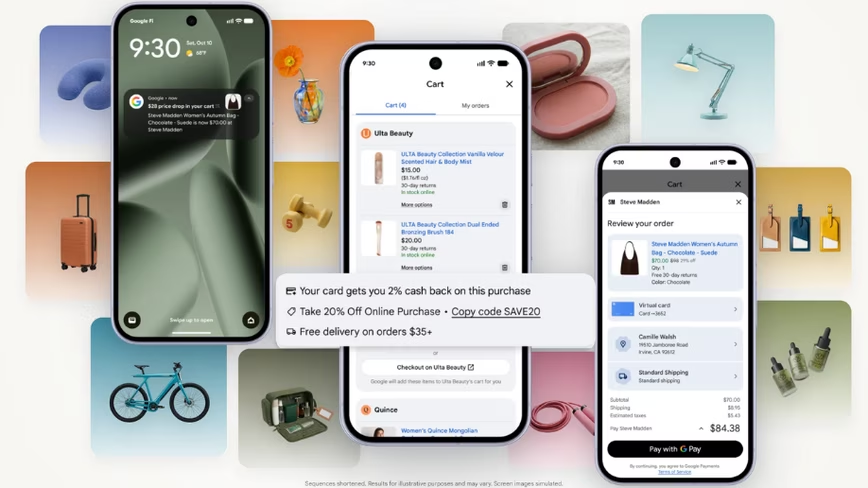
Googles Universal Cart. Die Bildschirmaufnahmen sind simuliert.
Google hat am Mittwoch Universal Cart in den USA gestartet, einen Warenkorb, der in die Suche und die Gemini App integriert ist, Produkte mehrerer Händler aufnimmt und die Zahlung über Google Pay abwickelt. Die eigene Roadmap des Unternehmens nennt Kanada, Australien und Großbritannien für die Expansion und erwähnt die EU mit keinem Wort.
Google hat einen Warenkorb in die Suche und die Gemini App integriert, der Produkte konkurrierender Händler aufnimmt und die Zahlung abwickelt. Gestartet ist er am Mittwoch in den USA. Googles eigene Roadmap nennt als nächste Ziele Kanada, Australien und Großbritannien und erwähnt die EU nicht.
Universal Cart basiert auf den 60 Milliarden Produkteinträgen im Shopping Graph von Google, wie das Unternehmen in einem Beitrag von Suresh Ganapathy mitteilte. In der I/O-Ankündigung im Mai hieß es, der Checkout werde innerhalb weniger Monate nach Kanada und Australien kommen und später in das Vereinigte Königreich.
Der Warenkorb sammelt Artikel verschiedener Händler an einem Ort, sendet Benachrichtigungen bei Preissenkungen und Wiederauffüllung des Bestands und greift auf Google Wallet zu, um vorzuschlagen, mit welcher Karte bezahlt werden soll. Außerdem zeigt er Rabattcodes an.
Zu den teilnehmenden Händlern zählen Nike, Sephora, Target, Ulta Beauty, Walmart, Wayfair sowie Shopify-Verkäufer. Jeder von ihnen bleibt der registrierte Verkäufer und kümmert sich um Bestellbestätigungen und Kundensupport.
Der Checkout läuft über das Universal Commerce Protocol, das im Januar als offener Standard veröffentlicht wurde. Googles Agent Payments Protocol, das es Agenten erlaubt, innerhalb vorgegebener Limits einzukaufen, wurde im September 2025 mit mehr als 60 Partnern eingeführt, darunter PayPal und Mastercard.
Dieser Mai-Plan sah den US-Start für den Sommer vor. Er kam am 15. Oktober.
Die Abwesenheit in Europa ist kein Versehen. Die Kommission verhängte im Juli eine DMA-Geldstrafe von 890 Millionen Euro gegen Google, davon 460 Millionen Euro wegen Selbstbevorzugung bei Suchergebnissen für Shopping, Hotels, Transport und Sport.
Google erhielt 60 Tage Zeit, damit aufzuhören, andernfalls drohen tägliche Strafzahlungen von bis zu 5 Prozent des weltweiten Durchschnittsumsatzes von Alphabet.
Seine Antwort war, die Suche schlechter zu machen. Nick Fox, Googles Suchchef, erklärte im September, die Änderungen würden das Nutzererlebnis für Europäer verschlechtern.
Ein Stockholmer Gericht ordnete zudem im Juli an, dass Google Klarnas PriceRunner fast 2 Milliarden US-Dollar zahlen muss, auf Basis der Google-Shopping-Entscheidung der Kommission aus dem Jahr 2017. Die EU-Geldstrafen gegen das Unternehmen übersteigen inzwischen 9 Milliarden Euro.
Google bringt seine agentic Funktionen bereits überall dorthin, nur nicht nach Europa. Gemini Spark, das Produkt, das laut Unternehmen als Erstes das Zahlungsprotokoll erhalten sollte, erreichte im Juli mehr als 160 Länder und ist im EWR, in der Schweiz und im Vereinigten Königreich nicht verfügbar. Ein Grund wurde nicht genannt.
Ein Warenkorb in Googles eigenen Suchergebnissen, der Einträge konkurrierender Händler aufnimmt und die Zahlung abwickelt, ist die Frage der Selbstbevorzugung in einer neueren Form.
Sechs Preisvergleichsdienste haben bereits Schadensersatzklagen vorbereitet, von Idealos Zuspruch von 465 Millionen Euro bis Moltiplys Forderung von 2,97 Milliarden Euro. Google hat nicht gesagt, ob der Warenkorb die EU erreichen wird.
Ana Maria Constantin verfügt über Fachkenntnisse in digitalem Marketing, Produktmanagement sowie Branding und Identität und entwickelt Strategien, die bei unserer Zielgruppe in der Software-/SaaS-Branche Anklang finden (alle anzeigen). Zusammenarbeit und Teamarbeit sind für sie von zentraler Bedeutung, denn es bereitet ihr Freude, ihre Kolleginnen und Kollegen zu unterstützen, herausragende Ergebnisse zu erzielen und ihr volles Potenzial zu entfalten.
Erhalten Sie jede Woche die wichtigsten Tech-News in Ihrem Posteingang.
Danke! Überprüfen Sie Ihren Posteingang, um Ihr Abonnement zu bestätigen.
Mit dem Abonnement stimmen Sie unserer Datenschutzerklärung zu.
Automatisch übersetzt. Das Original auf Englisch ist unten aufklappbar.
Original (Englisch) anzeigen
Google’s Universal Cart. Screen images are simulated.
Google launched Universal Cart in the US on Wednesday, a cart that sits inside Search and the Gemini app, holds products from multiple retailers and takes the payment through Google Pay. Its own roadmap names Canada, Australia and the UK for expansion, and never mentions the EU.
Google has put a shopping cart inside Search and the Gemini app that holds products from rival retailers and takes the payment. It launched in the US on Wednesday. Google’s own roadmap names Canada, Australia and the UK next, and never mentions the EU.
Universal Cart runs on the 60 billion product listings in Google’s Shopping Graph, the company said in a post by Suresh Ganapathy. Its I/O announcement in May said checkout would reach Canada and Australia within months, and the UK later.
The cart keeps items from different retailers in one place, sends alerts on price drops and restocks, and reads Google Wallet to suggest which card to pay with. It also surfaces promo codes.
Participating merchants include Nike, Sephora, Target, Ulta Beauty, Walmart, Wayfair and Shopify sellers. Each remains the seller of record, and handles confirmations and support.
Checkout runs on the Universal Commerce Protocol, released as an open standard in January. Google’s Agent Payments Protocol, which lets agents buy within preset limits, arrived in September 2025 with more than 60 partners including PayPal and Mastercard.
That May plan put the US launch in the summer. It arrived on 15 October.
Europe’s absence is not an oversight. The Commission issued Google an €890M DMA fine in July, €460M of it for self-preferencing in shopping, hotel, transport and sports results.
Google was given 60 days to stop, or face daily penalties of up to 5% of Alphabet’s average worldwide turnover.
Its answer was to make search worse. Nick Fox, Google’s search chief, said in September that the changes “ degrade the user experience for Europeans “.
A Stockholm court separately ordered Google to pay Klarna’s PriceRunner nearly $2B in July, on the Commission’s 2017 Google Shopping decision. EU fines against the company now exceed €9B.
Google already ships agentic features everywhere but Europe. Gemini Spark, the product it said would get the payments protocol first, reached more than 160 countries in July and is unavailable in the EEA, Switzerland and the UK. No reason was given.
A cart inside Google’s own results, holding rival retailers’ listings and taking the payment, is the self-preferencing question in a newer form.
Six comparison-shopping services are already lining up for damages, from Idealo’s €465M award to Moltiply’s €2.97B claim. Google has not said whether the cart will reach the EU.
With expertise in digital marketing, product management, and branding & identity, Ana Maria Constantin develops strategies that resonate (show all) With expertise in digital marketing, product management, and branding & identity, Ana Maria Constantin develops strategies that resonate with our target audience in the software/SaaS industry. Collaboration and teamwork are paramount to her, as she loves empowering her colleagues to achieve outstanding results and unlock their full potential.
Get the most important tech news in your inbox each week.
Thanks! Check your inbox to confirm your subscription.
By subscribing you agree to our Privacy Statement.