Imago Platform uses graphs to improve AI knowledge management
AI-powered knowledge management systems face a fundamental challenge when businesses need accurate answers rather than plausible ones. Imago Platform Ltd. encountered that problem while developing an application to help customers navigate complicated product warranty policies. Imago’s first client,
SHARE Coverage from SiliconANGLE's livestreaming video studio UPDATED 19:20 EDT / OCTOBER 13 2026
AI-powered knowledge management systems face a fundamental challenge when businesses need accurate answers rather than plausible ones. Imago Platform Ltd. encountered that problem while developing an application to help customers navigate complicated product warranty policies.
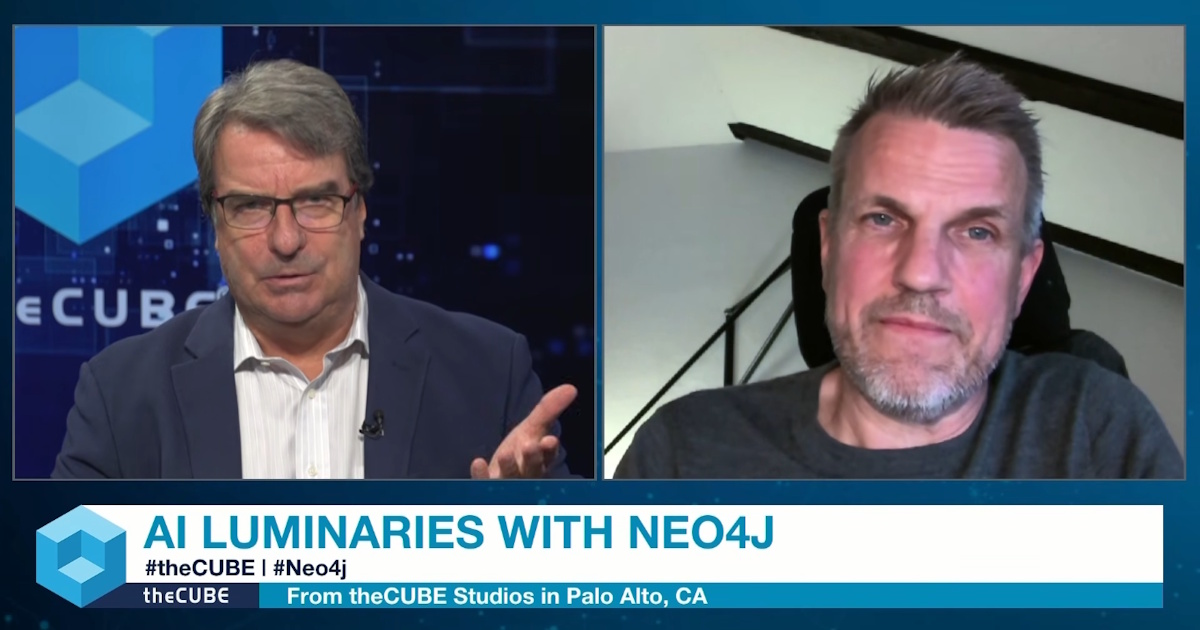
Imago’s first client, a lighting and electrical business, needed help resolving warranty claims across manufacturers with widely varying policies. The company ingested a large collection of PDF documents, but its AI model struggled to produce consistently accurate answers. Because the models generate probabilistic rather than deterministic responses, the approach fell short of the client’s requirements, according to Magnus Helander (pictured), co-founder of Imago Platform.
“We just couldn’t get the thing to 100% accuracy,” he said. “We got on the Neo4j Startup Program and got some help to start working with graphs, and suddenly … the model started delivering correct results again and again and again.”
Helander spoke with John Furrier for theCUBE + NYSE Wired: AI Luminaries interview series on theCUBE, SiliconANGLE Media’s livestreaming studio. They discussed how Imago Platform connects business systems into a secure, intelligent hub. (* Disclosure below.)
Imago Platform connects customer relationship management and enterprise resource planning systems with documents and email, bringing information from disparate sources together. Founded 18 months ago, the company also serves property management teams, car dealerships and retailers in Sweden.
“We have a product finder where you give it your needs, like for a car,” Helander said. “‘I have three kids and I commute; what can you recommend?’ Instead of going through the classic check boxes and trying to figure out which car is a good one from 300 alternatives, we were able to build a needs-based product engine. That would not have been possible without both a graph database and also a number of advanced search technologies.”
Imago Platform’s experience highlights the importance of grounding AI agents in relevant business information. Graph databases help establish relationships among disparate sources, giving agents a way to retrieve information in context rather than relying solely on a language model’s general knowledge, Helander explained.
“The models are designed to be helpful,” he noted. “If it doesn’t have data, it will generate it for you because that’s the definition of helpful, and then you get hallucinations. Something happens when you provide context to the model. This thing is connected to this thing, which is related to this thing in this way, and suddenly it just seems like a perfect match.”
AI agents can draw on databases, file storage, live data and application programming interfaces to carry out business tasks. As more business logic moves into the AI layer, developers also need ways to monitor agent activity and trace the steps agents take, Helander explained.
“Suddenly you have agents working in the background because they are deep down into a Kubernetes network or grinding away somewhere where you don’t really have observability,” he said. “You really have no idea how it arrived at that conclusion. Neo4j has saved us there. It can trace the agent’s work. It creates nodes for every step of this.”
Here’s the complete video interview, part of SiliconANGLE’s and theCUBE’s coverage of theCUBE + NYSE Wired: AI Luminaries interview series:
(* Disclosure: TheCUBE is a paid media partner for theCUBE + NYSE Wired: AI Luminaries interview series. Neither Neo4j, the sponsor of theCUBE’s event coverage, nor other sponsors have editorial control over content on theCUBE or SiliconANGLE.)
Support our mission to keep content open and free by engaging with theCUBE community. Join theCUBE’s Alumni Trust Network, where technology leaders connect, share intelligence and create opportunities.
Founded by tech visionaries John Furrier and Dave Vellante, SiliconANGLE Media has built a dynamic ecosystem of industry-leading digital media brands that reach 15+ million elite tech professionals. Our new proprietary theCUBE AI Video Cloud is breaking ground in audience interaction, leveraging theCUBEai.com neural network to help technology companies make data-driven decisions and stay at the forefront of industry conversations.
Scuba launches with $34M to help teams and AI agents manage business data
Gemini 4 Argon reaches Gemini app Pro and Ultra subscribers alongside a new tasks mode
Apple debuts new smart home devices, partner-developed hardware
Deliverance AI puts sovereign AI control to the continuity test
Ubitium raises $14M to build universal processor for machines that perceive, think and act
Spranic builds spatial memory for physical AI
CLOUD - BY MARIA DEUTSCHER. 22 MINUTES AGO
© 2026 SiliconANGLE Media Inc. All rights reserved.