NiCE bets the company on AI, data and accountability, and the legacy business buys it time
Every company in the customer experience ecosystem now claims to be an artificial intelligence company. Last week, at NiCE Ltd.’s annual industry analyst summit, the company demonstrated what happens when an AI strategy shifts the organization’s center of gravity. A year after closing the Cognigy a
SHARE UPDATED 15:03 EDT / OCTOBER 19 2026
Every company in the customer experience ecosystem now claims to be an artificial intelligence company. Last week, at NiCE Ltd.’s annual industry analyst summit, the company demonstrated what happens when an AI strategy shifts the organization’s center of gravity.
A year after closing the Cognigy acquisition, NiCE is no longer a contact center-as-a-service or CCaaS provider with AI bolted on. It’s an AI platform that happens to include the industry’s deepest CCaaS and workforce engagement stack. Even before the Cognigy purchase, I felt NiCE led the CCaaS industry, and the event only reinforced that view.
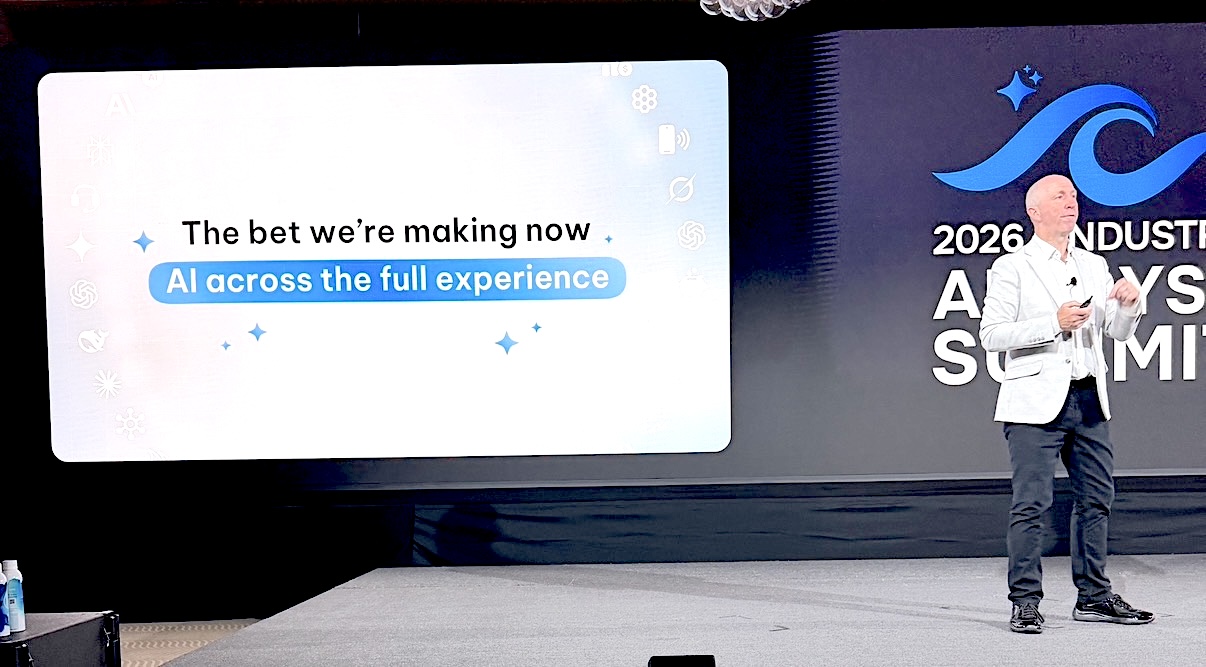
During his keynote, Chief Executive Scott Russell (pictured) spoke at length about how the deal transformed the company. “Most acquisitions that companies make expand the portfolio and the capability,” he said. “This one changed where we build from. It changed the nature of who we are as a company.” Jeff Comstock, president of CX product and technology, said Cognigy is “now the underlying substrate for all of our conversational and agentic AI across the entire platform.”
What I found equally interesting is that NiCE isn’t using Cognigy solely to lock in CXone customers. Philipp Heltewig, Cognigy’s co-founder and now NiCE’s chief AI officer, said that the standalone motion of selling Cognigy on top of Genesys, Five9 or Amazon Connect “is equally important to us as the integrated motion.” Russell noted that he has yet to see a rival’s AI running on NiCE, whereas Cognigy runs on theirs.
Cognigy has a large customer base on competitive platforms, and it can be tempting to shut that down and force other vendors to scramble for new partners. It’s the right thing for NiCE to keep selling Cognigy that way because it’s best for customers, and that’s always the best path.
NiCE’s real asset is no longer the routing engine or the ability to offer multiple channels. That’s table stakes. NiCE’s strength and competitive moat is its decades of interactions, analytics, and screen recordings originally captured for compliance, which multimodal models can now reason over. Comstock demoed a system that observed a human agent process a refund across voice, screen, and telemetry, then built an AI agent from that observation, including a $250 supervisor-approval guardrail it inferred on its own.
Speaking of the AI startups that partner with NiCE, Russell said, “They need NiCE data. They need our workloads. They need our interactions. They need our intents.” In the Q&A, he added: “There’s no doubt the power of our data is a huge value, not just the interaction data, but the contextual real-time data, the human behavior behind it, the screen record.”
The numbers support that statement. Prospects that get an automated insights readout based on their own data book nine times more AI than those that don’t, and application programming interface volume off the platform is up 7.5 times in two years. Asked whether NiCE would package that intelligence for sales, marketing and the C-suite, Russell said, “Yes, it’s coming, just not right now.” That’s the long-term story. Systems of record capture what happened; NiCE captures how it happened.
Historically, part of what NiCE did was help customers understand and manage their customers’ journeys. At the event, Russell made an interesting comment, saying, “Companies can no longer own the customer journey.” Consumer AI agents don’t sleep, don’t give up and don’t care about your interactive voice response tree.
Demand, once limited by human patience, is about to surge. Dave Meyer of Hyatt said it’s already happening, starting in Asia. “You have bots talking to bots,” he said, “We don’t have any historical baselines.” His advice is not to “fear the bots,” because “there’s a customer behind every single one of these inquiries.”
Banking isn’t there yet. Mia Carrera, head of customer excellence at Citi, said, “When you’re dealing with your money, there’s no tolerance for error,” though attitudes are shifting.
“The race we are in is not about the smartest agent,” Russell said. “I see some of these announcements about these AI players, and I roll my eyes.” Accountability must shift from design time to runtime, with humans and AI agents held to the same standard.
From a company perspective, one of the most important points came during the analyst Q&A, when Russell was asked why 50%-plus AI growth isn’t showing up in overall revenue and whether AI expands NiCE’s market or cannibalizes it. Russell said reported revenue blends very different growth profiles: workforce management, analytics, Actimize and public safety don’t grow like CCaaS and AI. “If you look at CXone and NiCE Cognigy, those numbers will blow you away,” he said. “I am obsessed with long-term, durable growth, not with what happened last or this quarter.”
“That 52% year-over-year ARR is not from pilots and POCs,” Russell said. It counts only multiyear commitments, and backlog is growing faster. The bottleneck is deployment, which is why Heltewig’s 30-day time-to-value goal is so important.
This is a point many miss, and it explains why the stock has moved sideways since the Cognigy acquisition. The timing of AI revenue is uncertain because enterprises move slowly. NiCE’s large, sticky installed base gives it time to navigate the transition. Pure-play AI startups lack that cushion, and Russell said customers increasingly realize that many of those startups’ economic models “don’t stack up.”
When I asked about outcome-based deals, Russell said premium customers are defaulting to enterprise license agreements that mix seats, consumption, and outcomes. “Predictability is right now even more important than outcome,” he said. Seats never monetized efficiency; now, “With the AI workloads, we clipped the ticket on everyone.” If seats decline, spend shifts to AI workloads rather than leaving.
That said, investors dislike uncertainty, and anything Russell can do to clarify when AI creates a step function in the company’s growth will help. It’s worth noting that this is an issue not just for NiCE but for the entire CX industry. AI will likely reduce the number of human seats sold, but the revenue upside from AI usage should dwarf that. How and when this happens remain unknown, so many investors sit on the sidelines.
Treat interaction data as a strategic asset. Call recordings, transcripts, quality scores and screen recordings were once compliance artifacts stored until legal needed them. Now they’re the raw material for building, testing, and tuning AI agents, as NiCE’s demos showed. Information technology leaders should inventory where that data lives, how long it’s retained,and who can access it. Every platform contract, NiCE or otherwise, should guarantee that the enterprise can retrieve that data in a usable form. Whoever controls the interaction data will control how fast you can automate, so don’t let it be locked inside a vendor’s walls.
Plan for agent traffic now. Personal agents aren’t a 2028 problem. Hyatt is already seeing them, and the company’s biggest challenge is the lack of a historical baseline to plan against. Start by measuring how much inbound traffic is machine-generated, what those agents are asking for, and when they appear. Then work with security teams to determine how you’ll verify that an agent truly represents a customer and what it’s allowed to do on that customer’s behalf. Capacity planning also needs a rethink, since a single viral post can send millions of agents to your front door at once.
Budget for change management. Every customer on stage said the technology was the easy part. Hyatt’s Meyer agreed, favoring a 70/30 split between change management and deployment. Jermain Smith, senior director of customer support at Valvoline, noted that the company more than doubled containment and cut one group’s staff by about 30% through attrition alone. It got there in part by adjusting agent metrics before rollout, so employees weren’t penalized when the AI took over coupon and pricing calls. Citi took a similar approach, making it clear that frontline agents wouldn’t be held responsible when the AI running in the background made a mistake. IT should own the deployment, but it needs human resources, operations and frontline managers in the room from day one.
Get the knowledge base right first. Russell made a point that’s easy to overlook: Human agents can work around inaccurate or outdated knowledge articles through training and experience, but AI agents can’t. They’ll confidently repeat whatever they’re given. Before scaling AI agents, audit the knowledge content they’ll rely on, assign owners and put a process in place to keep it current. This unglamorous work often separates a stalled pilot from a production deployment.
Measure resolution, not containment. Containment is the metric most companies start with, and it’s easy to inflate. A customer who gives up and hangs up counts as “contained.” Hyatt is moving toward measuring whether the customer’s original intent was resolved, along with the accuracy of the information the AI provides. Citi treats accuracy as the metric that matters most. Define what a resolved interaction means for your business before you deploy, and ensure your vendor reports against that definition.
Negotiate for predictability. Outcome-based pricing sounds great until success makes it expensive, and the definition of a completed task can vary widely. Russell said most large customers are choosing predictable models, and that’s the right instinct for now. Look for enterprise license agreements that let spend move across seats, consumption and outcomes as your mix of human and AI agents changes. Also, model token costs before committing, since several customers saw costs balloon and had to switch models mid-deployment.
NiCE did what it said it would a year ago. The open questions are about execution: how quickly backlog turns into revenue, whether 30-day time to value holds in regulated enterprises, and how aggressively NiCE pushes to monetize its data.
NiCE’s advantage isn’t any single agent. It’s an installed base that funds the transition and a data asset no AI startup can replicate. Many of its traditional peers lack the resources or the data platform to deliver the depth of insight. If personal agents drive the demand surge Russell expects, enterprises will need a platform to absorb, govern, and learn from it. NiCE is betting it’s that platform.
Zeus Kerravala is a principal analyst at ZK Research, a division of Kerravala Consulting. He wrote this article for SiliconANGLE.
Support our mission to keep content open and free by engaging with theCUBE community. Join theCUBE’s Alumni Trust Network, where technology leaders connect, share intelligence and create opportunities.
Founded by tech visionaries John Furrier and Dave Vellante, SiliconANGLE Media has built a dynamic ecosystem of industry-leading digital media brands that reach 15+ million elite tech professionals. Our new proprietary theCUBE AI Video Cloud is breaking ground in audience interaction, leveraging theCUBEai.com neural network to help technology companies make data-driven decisions and stay at the forefront of industry conversations.
Neural Concept launches MCP to help AI agents operate commercial CAD tools
Motive brings agentic AI to physical operations with agents that act before problems escalate
Fortanix extends Confidential AI to Kubernetes workloads through Confidential Containers
Motive Technologies revs up new AI Agents to automate fleet management
Axonius launches AI Workforce virtual workers as AI Companion and MCP Server go live
Chip legend Jim Keller's Tenstorrent raises $1.5B to expand its open compute ecosystem
© 2026 SiliconANGLE Media Inc. All rights reserved.