Nvidia turns the AI factory into a product, and agents into the workload
For most of the past half-decade, the narrative around Nvidia Corp. has largely centered on the graphics processing unit. The questions have been who has allocation, how much faster the next generation is and whether anyone can close the gap. At GTC Berlin early today, Chief Executive Jensen Huang
SHARE UPDATED 16:52 EDT / OCTOBER 21 2026
For most of the past half-decade, the narrative around Nvidia Corp. has largely centered on the graphics processing unit. The questions have been who has allocation, how much faster the next generation is and whether anyone can close the gap.
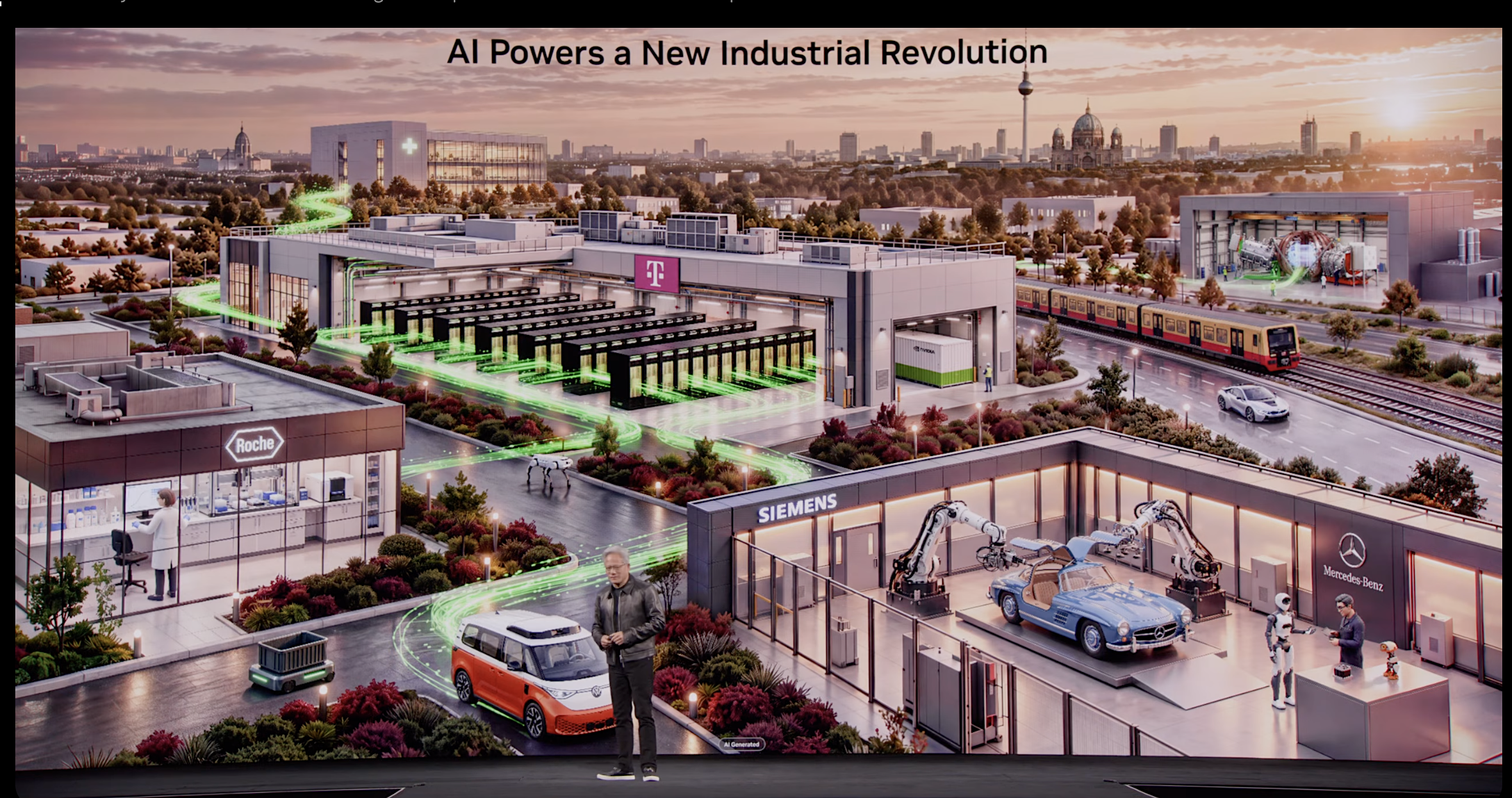
At GTC Berlin early today, Chief Executive Jensen Huang spent surprisingly little of his keynote on silicon. Instead, he argued that artificial intelligence constraints have shifted to deployment speed, power, security, and the ability to put enterprise data to work, and that Nvidia intends to have an answer for each. “We were early to observe that, in fact, AI is a manufacturing industry,” Huang told the audience. “Rather than a tool that’s used by us, it is now part of machinery, an infrastructure, factories that are producing intelligence.”
Those comments from Huang tie together most of the massive news payload from Berlin. A summary of the news includes Nvidia introducing DSX POD, a reference design for complete Vera Rubin AI factories built by partners in containers; launching the OpenShell Reference Architecture to run agents safely; expanding its Agent Toolkit with an Agent Knowledge Foundation and a new family of structured-data models called Kumo; and deepening its push into telecom with Nokia and European operators. Individually, these are product launches. Together, they show Nvidia moving from selling the most important component in AI to selling the operating model for AI.
One of the more interesting moments in the keynote came when Huang did back-of-the-envelope math on stage. A one-gigawatt AI factory costs about $50 billion and should generate roughly $40 billion in annual revenue. Delay it by a quarter, and about $10 billion in revenue is lost. “$10 billion worth of revenue will make anybody anxious,” he said.
That’s an interesting and correct way to think about AI infrastructure economics. The cost that keeps AI builders up at night is no longer the price of hardware; it’s the cost of hardware sitting idle while crews pull cable. A modern AI build is a construction project, with kilometers of copper and fiber assembled on site by scarce, specialized labor, especially in Europe.
DSX POD embeds that work into the factory and hides the complexity from the customer. Each pod holds seven Vera Rubin NVL72 racks, with roughly 20 kilometers of NVLink copper and 17 kilometers of scale-out networking, all cabled, plumbed, and tested before shipment. Nvidia says that deployment at a prepared site drops from six months to as little as 14 days.
The more interesting question is where this fits. DSX POD won’t replace gigawatt campuses, which still benefit from economies of scale. The sweet spot is the hundreds-of-megawatts tier, where an operator has a site and power but lacks the time or permitting runway for a full land, power, and shell build. That’s exactly where Europe’s neoclouds, sovereign AI projects, and telcos operate. The 14-day figure assumes the site is ready, with delivery set for early 2027. Containers compress integration, but they don’t fix grid interconnect queues. DSX POD shifts the long pole in the tent; it doesn’t remove it.
The DSX platform beneath the pod is where Nvidia does some of its most important engineering work, which tends to fly under the radar. Warm-water, closed-loop cooling lets operators in suitable climates skip evaporative towers, which Nvidia estimates saves 54 million liters of water per day at two gigawatts. DSX MaxLPS directs power to where workloads need it, and Nvidia says this delivers the same output with up to 30% less power.
The piece I’d watch most closely is DSX Flex. During the Euro 2020 match between England and Germany, millions of Britons put the kettle on at halftime, and the grid saw roughly a one-gigawatt spike. Today, when a grid operator needs a data center to back off, the process is mostly manual, often a phone call. DSX Flex automates that interaction, allowing AI factories to defer or throttle work and return capacity.
That matters because data centers that behave like flexible loads are easier to connect and more readily accepted by communities. The industry must stop treating data centers purely as consumers on the grid and start treating them as partners to grid operators. Hyperscalers are already moving in this direction; the difference is that Nvidia is trying to make it a standard.
The second half of the keynote shifted from the factory to what runs inside it, increasingly agents rather than models. Huang described an agent as consisting of five parts: the model, the harness, the sandbox, knowledge, and tools. He was clear about the priority. “The agent is an autonomous system that has access to files, resources, and networks, as well as tools, and we need to make sure that the privileges we provide this autonomous system are minimal and that we constantly monitor it,” he said.
Much of the AI safety debate has centered on model alignment and guardrails, assuming a well-behaved model is enough. It isn’t. No model can be trained to understand the policy requirements of every business and regulated industry. Agents are probabilistic systems that will find creative ways to solve problems, and some of those approaches will touch data or take actions no one intended. They need deterministic controls enforced outside their reach.
That’s the thesis behind the OpenShell Reference Architecture. Harnesses run on Vera CPUs, models run on Vera Rubin, and BlueField-4 with Nvidia Sentry runs as an isolated monitor between them, capable of cutting off an agent in milliseconds. Network professionals will recognize the pattern. That’s why the industry moved away from host-based security alone and shifted enforcement into the network. It also lets security teams author policies for their own country and industry, which is especially important in Europe.
As expected, the ecosystem response to align with Nvidia has been strong, with CrowdStrike, Palo Alto Networks, Zscaler, Cisco, and others adding support. The question is whether OpenShell, which is open source and runs on x86 or Arm, can provide hardware-isolated enforcement without BlueField. Enterprises should distinguish the protections available through OpenShell software from the additional hardware enforcement provided by BlueField-4 and Sentry.
“What turns these agents into super agents is giving them access to your company’s knowledge,” Huang said. Enterprises hold an estimated 70% of the world’s data, and most of it hasn’t been prepared for agents. The industry’s attention has focused mostly on documents and PDFs, yet much of the business value lies in the rows and columns of ERP, supply chain, and financial systems, and language models aren’t built to reason over that data. Historically, getting a prediction from a table meant building a custom model for a single question. Kumo is a family of predictive models l that can answer many “what-if” questions against the same data. That’s the kind of capability that turns agents from chat interfaces into operational tools.
It also debunks the ridiculous “AI will kill software” narrative. “Some people said that AI is going to be the end of software, the end of tools companies,” Huang said. “It’s exactly the opposite.” I agree. Agents need simulators, solvers, and databases, and the companies that own those tools become more valuable when they package them for agents.
Huang also made a bold telecom prediction. “Every single telco in the future, with 100,000 sites representing some 100 gigawatts of distributed telco base stations and data centers, will evolve into a distributed AI network,” he said.
The European numbers support the thesis. About 20% of Europe’s data centers are owned by telcos, and there are more than 1,500 telco facilities that could host GPUs. I’ve watched operators chase edge compute before, and multi-access edge computing never delivered. The difference now is a real inference workload, plus the ability to run the radio network itself on the same platform, as T-Mobile and Nokia demonstrated with the first AI-RAN call on a commercial network. Physical AI strengthens the case. Robots will handle perception on board but will sometimes need to “phone a friend” to an on-premises server, a telco edge site, or the cloud. That hybrid model fits operators well, provided they can build the go-to-market muscle to sell it.
Physical AI is no longer a science project for Nvidia, either. The company said physical AI revenue reached nearly $11 billion in the first half of 2026, about 30% higher than all of last year. Europe, with its precision manufacturing base and Mittelstand of midsize manufacturers, has the most to gain now that the technology is good enough for companies without in-house robotics teams.
As mentioned, telcos have had opportunities to increase their value to customers before. Cloud, mobile, and the Internet put telcos in a position to be something other than a commodity, but they failed. However, this time Nvidia is helping them make this shift, and the upside for Nvidia is high if the telcos succeed.
Nvidia describes its approach as vertically optimized but horizontally open, meaning customers can use as much or as little of the stack as they want. Berlin showed how far the vertical part now extends, from container logistics and grid integration to agent security and structured data models. The more of the stack Nvidia supplies, the more that openness promise will be tested, and buyers should hold the company to that promise.
But the strategic point has been made. Nvidia’s rivals are still largely competing on chips, while Nvidia is increasingly competing on time to revenue, backed by an installed base where Volta GPUs from 2019 are still serving customers. For CIOs and operators weighing multibillion-dollar AI investments, that durability, combined with faster time to first token, is a harder argument to beat than any benchmark.
Zeus Kerravala is a principal analyst at ZK Research, a division of Kerravala Consulting. He wrote this article for SiliconANGLE.
Support our mission to keep content open and free by engaging with theCUBE community. Join theCUBE’s Alumni Trust Network, where technology leaders connect, share intelligence and create opportunities.
Founded by tech visionaries John Furrier and Dave Vellante, SiliconANGLE Media has built a dynamic ecosystem of industry-leading digital media brands that reach 15+ million elite tech professionals. Our new proprietary theCUBE AI Video Cloud is breaking ground in audience interaction, leveraging theCUBEai.com neural network to help technology companies make data-driven decisions and stay at the forefront of industry conversations.
Critical PHP vulnerabilities send organizations scrambling to secure their systems
In a tight AI market, Dell says supply matters more than price
Comet Cloud targets small businesses underserved by GPU cloud providers
Era4 ties financial sovereignty to Britain’s AI infrastructure
Legal AI startup Legora raises $550M at $8.8B to change the face of the law
Red Hat and Nvidia expand their partnership to secure autonomous AI agents
SECURITY - BY MARIA DEUTSCHER. 29 MINUTES AGO
INFRA - BY SLOANE KALI FAYE. 2 HOURS AGO
INFRA - BY SLOANE KALI FAYE. 3 HOURS AGO
© 2026 SiliconANGLE Media Inc. All rights reserved.