Trump declares robot imports a national security threat
President orders trade talks on foreign-made factory robots, threatens tariffs.
That factory robot you like may be going out of style Trump declares robot imports a national security threat President orders trade talks on foreign-made factory robots, threatens tariffs.
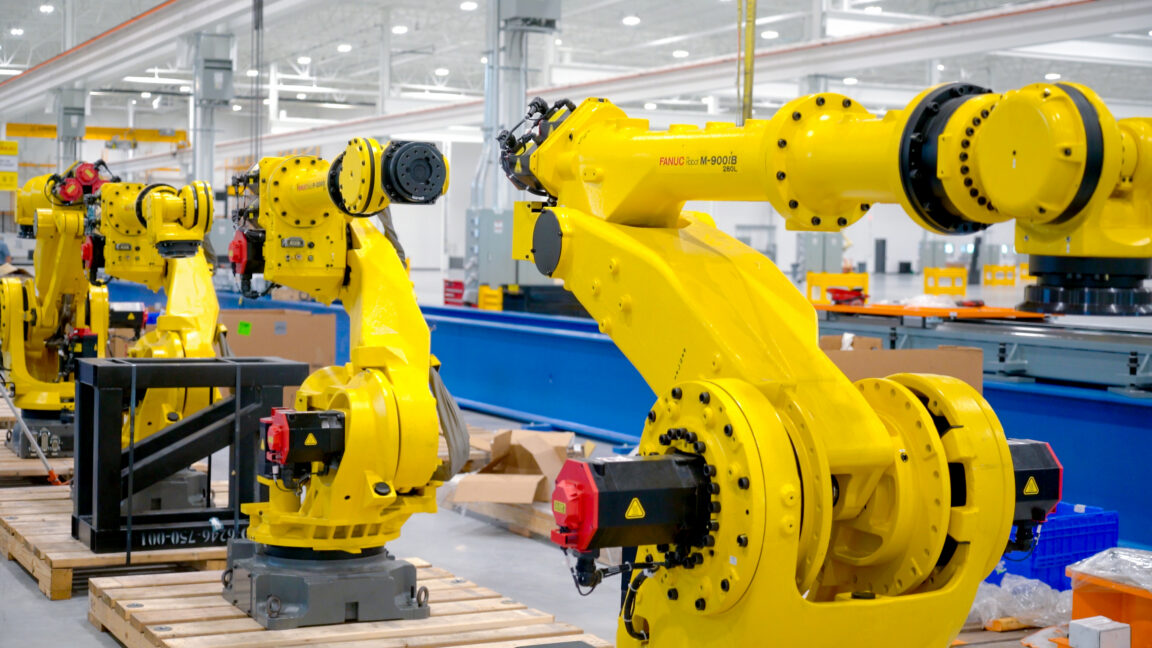
17 Heavy industrial robotic arms made by the Japan-based company FANUC stand ready for sale at the company's West Campus facility in Auburn Hills, Michigan. Credit: FANUC America Heavy industrial robotic arms made by the Japan-based company FANUC stand ready for sale at the company's West Campus facility in Auburn Hills, Michigan. Credit: FANUC America Text settings Story text Size Small Standard Large Width * Standard Wide Links Standard Orange * Subscribers only Learn more Minimize to nav President Donald Trump has declared the imports of foreign-made factory robots to be a national security threat—ordering new US negotiations with trading partners while holding out the possibility of imposing new tariffs on such robot imports in the future.
Issued on October 28, Trump’s presidential proclamation represents heightened government scrutiny of foreign-made industrial robots that could complicate the manufacturing operations of major US corporations that rely on such robots. Those companies include Detroit automakers General Motors and Ford, electric vehicle manufacturer Tesla, and aerospace and defense giants like Boeing and Lockheed Martin.
Trump’s proclamation describes industrial robots and machinery as being crucial for producing US military weapon systems along with representing a “driving force” behind all critical infrastructure sectors within the US economy. The proclamation cites an investigation under US Secretary of Commerce Howard Lutnick as having found that US imports of such robots “pose[] risks to the United States industrial base and threatens the long-term competitiveness of the United States in a sector that is increasingly vital to national security.”
The Department of Commerce investigation also supposedly found “unique security and safety risks” that may introduce “significant cybersecurity vulnerabilities that can result in severe consequences to the United States.”
Such wording echoes justifications used by Trump’s Federal Communications Commission when it banned new models of foreign-made robots, such as robotic vacuums, four-legged robot dogs, and humanoid robots, in July 2026. But that FCC action had specifically exempted industrial robot arms and other fixed or stationary robots commonly deployed in automotive factories and logistics warehouses.
Now Trump’s directive for the United States and trading partners “to adjust imports of robotics, industrial machinery, and their components” aims to strike new agreements on the issue within 180 days of the proclamation’s date. If no agreements have been reached by then, the proclamation warns that the president may take additional actions, like imposing “tariffs, duties, quotas, and fees” on such imports.
Any tariffs or other fees would, of course, be paid by the US companies importing such foreign-made robots. That would likely increase the cost of US manufacturing operations at a time when the United States has become the second largest market in using industrial robots, with the International Federation of Robotics reporting nearly 38,500 new US installations of industrial robots in 2025.
Major US automotive and aerospace companies often buy large robotic arms for factory floor work from the “big four” robotics makers—FANUC, ABB, Yaskawa, and KUKA—that are headquartered in Japan, Switzerland, and Germany. No US company currently offers comparable heavy-duty hardware for large industrial robotic arms, although the foreign robotics makers have been expanding their US engineering and assembly facilities.
Even Amazon, the company that has arguably deployed more robot workers than any other in the world, still uses some foreign-made robots, like Japan’s FANUC robotic arms, despite having significantly ramped up its own in-house robot production and developed certain specialized robotic arms.
Trump’s own proclamation acknowledges that US robotics companies do not produce enough industrial robots to “meet national security needs,” and that the United States “relies on foreign imports for most types of robotics and industrial machinery and for their components.”
If Trump does eventually slap tariffs on US imports of foreign-made industrial robots, that would at least fall short of restricting imports outright. Though as Intel recently showed, major US companies can still get waivers from the Trump administration to continue using foreign-made robots even when a nominal ban is in place.