Uber Builds MCP Gateway to Govern Access to 800+ Servers and 5,000+ AI Agent Tools
Uber has built an MCP Gateway to standardize how AI agents discover and invoke internal services across more than 800 MCP servers and 5,000 tools. The gateway separates tool registration from runtime execution and includes automated API discovery, access controls, sensitive data redaction, incremen
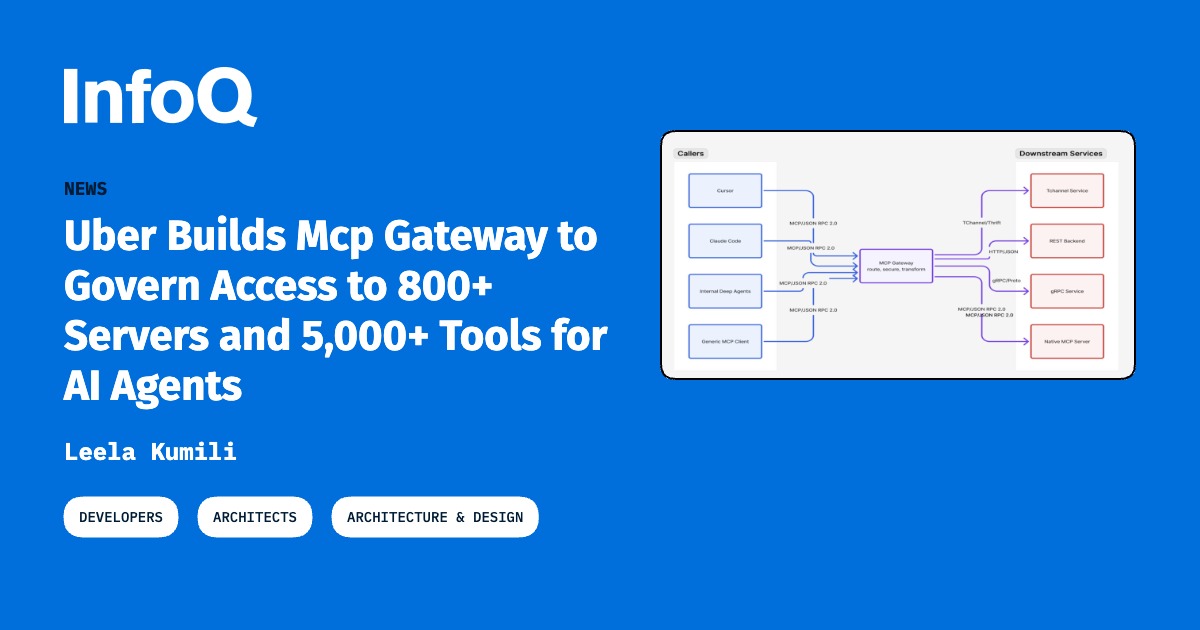
Uber engineers describe this approach as a microservice architecture that exposes existing APIs as MCP tools without requiring changes to the underlying services. The architecture separates the MCP Registry, which acts as the control plane, from the Proxy Gateway, which handles runtime execution. The registry maintains tool definitions, schemas, ownership, and enablement settings, while the proxy translates MCP requests into HTTP, gRPC, or TChannel calls and converts responses back into MCP-compatible results.
Uber MCP Gateway with APIs as tools (Source: Uber Blog Post)
The architecture has drawn comparisons with established API gateway patterns. Ajay Sharma, Principal Software Engineer at Microsoft CoreAI, wrote in a LinkedIn post,
Azure API Gateways has been doing this for a while now. It's a recipe for order to the chaos that LLMs come with.
Kelly Goetsch, President at Pipe17, similarly observed in a LinkedIn post that
Uber's new MCP gateway looks identical to gateways we've built over the decades for APIs and later GraphQL.
Tamir Dresher highlighted in a LinkedIn post the continuing relevance of established distributed systems concerns, including security, discovery, observability, and governance.
Uber’s AutoCrawler automates tool discovery using Cadence. It scans internal interface definition language (IDL) registries and extracts API definitions from Protocol Buffers and Thrift schemas. It then generates MCP-compatible schemas and uses a large language model to produce tool descriptions. Newly discovered tools remain disabled until their owning teams review and explicitly enable them. Configuration changes propagate to the data plane without requiring service restarts or redeployments.
Auto Crawler Flow (Source: Uber Blog Post)
The gateway enforces authorization at both server and tool levels through Uber’s internal access control system. It also supports redaction of personally identifiable information (PII) and other sensitive data in tool responses. For third-party integrations, including Jira and Google, a separate service exchanges internal user tokens for the corresponding third-party authentication tokens.
As the tool catalog grows, loading definitions for thousands of tools into an agent’s context becomes inefficient. Uber developed Omni MCP to support incremental discovery, allowing agents to search for servers, discover relevant tools, retrieve individual schemas, and invoke selected tools as needed. Response Projection lets agents request specific response fields instead of receiving complete payloads. Uber’s aifx command-line interface also enables coding agents to discover and invoke tools, writing results to files for selective inspection.
PostgreSQL Built for Time-Series Scale Handle massive time-series data with PostgreSQL, without sacrificing performance. Discover how Tiger Data delivers high-speed ingest, fast queries, and scalable storage. Learn More.