GitHub migriert Copilot-Runtime in rund 15 Wochen von TypeScript zu Rust
GitHub hat über 800.000 Zeilen Code der Copilot-Runtime mit KI-Unterstützung von TypeScript und Node.js zu Rust umgezogen. Die schrittweise Migration mit N-API-Interoperabilität, automatisierten Tests und menschlichem Review lief über 128 Pull Requests, ohne dass Releases pausiert wurden.
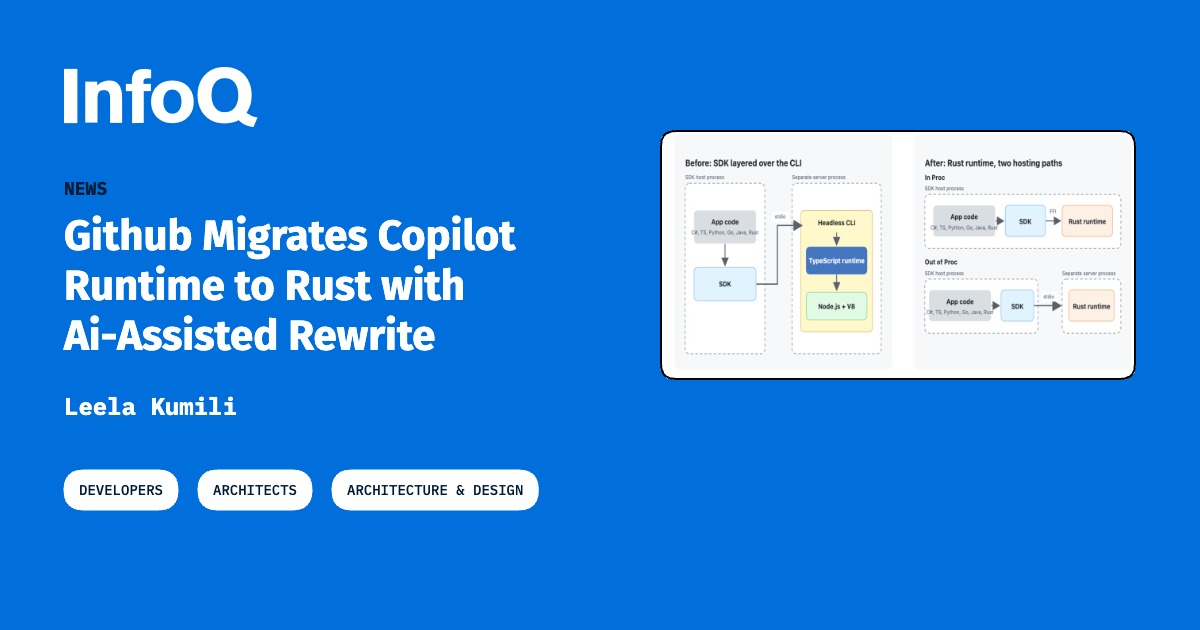
Die Migration veränderte auch die Art und Weise, wie Anwendungen in die Runtime integriert werden. Die vorherige Implementierung erforderte Node.js und V8 und kommunizierte über eine Prozessgrenze mit den Host-Anwendungen. GitHub erklärt, dass dies pro Client etwa 100 MB Working Set zusätzlich beanspruchte. Die Rust-Implementierung kann stattdessen über eine C-ABI direkt in Host-Anwendungen eingebettet werden, während ein Out-of-Process-Modus weiterhin verfügbar bleibt. Das Copilot SDK unterstützt derzeit TypeScript, Python, Go,.NET, Java und Rust.
GitHubs Copilot-Runtime-Architektur vor und nach der Migration (Quelle: GitHub Blog Post )
GitHub setzte auf eine schrittweise Austauschstrategie statt auf eine parallele Neuentwicklung mit anschließendem einmaligem Wechsel. Einzelne TypeScript-Komponenten wurden durch Rust-Implementierungen ersetzt, wobei eine vorübergehende N-API-Interoperabilität beide Welten verband. So konnten bestehende End-to-End-Tests den neuen Code ausführen, während andere Komponenten noch in TypeScript vorlagen. Während der Migration veröffentlichte GitHub 135 Releases, darunter 35 stabile und 100 Prerelease-Versionen.
Die Kompatibilitätsschicht erreichte 2.019 interne N-API-Exporte und 3.356 TypeScript-Aufruftpunkte, bevor sie entfernt wurde. Zum 21. August enthielt die Runtime 832.378 Zeilen produktiven Rust-Codes und 468.689 Zeilen Rust-Unit-Tests. Den Großteil der Implementierung erstellten KI-Agenten, während Kompilierung, Tests und manuelle Prüfung halfen, Regressionen bei Verhalten, Zustands- und Lebenszyklusbehandlung, Bibliothekssemantik sowie verlorenen Optimierungen aufzudecken. GitHub verzeichnete 4.478 direkte cargo-check-Läufe, von denen 87,1 Prozent fehlerfrei durchliefen.
Die Reaktionen der Community konzentrierten sich ebenfalls auf die Herausforderungen der Verifikation bei KI-gestützten Migrationen und nannten Abbruchverhalten, Wiederholungsversuche und Backpressure als Beispiele, die eine Validierung über die reine Kompilierung hinaus erfordern. PLBjt schrieb, dass
das Interessante hier weniger daran liegt, dass Copilot Rust geschrieben hat, sondern daran, ob die Migration das Verhalten der Runtime an den Schnittstellen stabil gehalten hat.
Francesco Pira, XR Tech Lead bei Leonardo, hob hervor,
dass Tests in kleinen überprüfbaren Änderungen, Kompatibilitätsschichten und technisches Urteilsvermögen von Menschen wichtige Elemente des Vorgehens waren.
Côme Redon, Senior Solution Engineer bei Microsoft, verwies auf
die Herausforderung, undokumentierte Verhaltensverträge in Legacy-Systemen zu identifizieren.
GitHubs Migrationszeitplan mit den inkrementellen Pull Requests und Releases. (Quelle: GitHub Blog Post )
Die daraus resultierende Architektur bietet eine native Rust-Runtime, die entweder direkt in Host-Anwendungen eingebettet oder separat betrieben werden kann, während das Copilot SDK sprachspezifische Schnittstellen für die unterstützten Sprachen beibehält. Die Migration kombinierte KI-generierte Implementierung mit inkrementeller Integration, vorübergehenden Kompatibilitätsgrenzen, automatisierter Validierung und manueller Prüfung, während die Runtime im produktiven Einsatz weiterentwickelt wurde.
15. bis 16. Dezember 2026. Erfahren Sie, wie erfahrene Praktiker Agents, Evals, Model Serving und KI-gestützte Entwicklung in der Produktion einsetzen, inklusive dessen, was fehlschlug und was sich änderte. Jetzt registrieren.
Automatisch übersetzt. Das Original auf Englisch ist unten aufklappbar.
Original (Englisch) anzeigen
The migration also changed how applications integrate with the runtime. The previous implementation required Node.js and V8 and communicated with host applications across a process boundary. GitHub says this added approximately 100 MB of working set per client. The Rust implementation can instead be embedded directly into host applications through a C ABI, while an out-of-process mode remains available. The Copilot SDK currently supports TypeScript, Python, Go,.NET, Java, and Rust.
GitHub’s before and after Copilot runtime architecture (Source: GitHub Blog Post )
GitHub used an incremental replacement strategy rather than a parallel rewrite followed by a single cutover. Individual TypeScript components were replaced with Rust implementations, with temporary N API interoperability connecting the two. This allowed existing end-to-end tests to exercise the new code while other components remained in TypeScript. GitHub shipped 135 releases during the migration, including 35 stable and 100 prerelease versions.
The compatibility layer reached 2,019 internal N API exports and 3,356 TypeScript call sites before being removed. By August 21, the runtime contained 832,378 lines of production Rust and 468,689 lines of Rust unit tests. AI agents generated most of the implementation, while compilation, testing, and human review helped identify regressions involving behavior, state and lifetime handling, library semantics, and lost optimizations. GitHub recorded 4,478 direct cargo check runs, with 87.1% completing cleanly.
Community responses also focused on the verification challenges of AI-assisted migrations and pointed to cancellation, retries, and backpressure as examples requiring validation beyond compilation. PLBjt wrote that
The interesting part here is less that Copilot wrote Rust and more whether the migration kept the runtime’s behavior stable at the boundaries.
Francesco Pira, XR Tech Lead at Leonardo, highlighted
Tests small reviewable changes, compatibility layers, and human engineering judgment as important elements of the approach.
Côme Redon, Senior Solution Engineer at Microsoft, pointed out
The challenge of identifying undocumented behavioral contracts in legacy systems.
GitHub’s migration timeline showing the incremental pull requests and releases. (Source: GitHub Blog Post )
The resulting architecture provides a native Rust runtime that can be embedded directly into host applications or operated separately, while the Copilot SDK maintains language-specific interfaces across its supported languages. The migration combined AI-generated implementation with incremental integration, temporary compatibility boundaries, automated validation, and human review while the production runtime continued to evolve.
December 15–16, 2026. Examine how senior practitioners run agents, evals, model serving, and AI-assisted engineering in production, including what failed and what changed. Register Now.